
Jack Smith Didn’t Clear Trump on Jan. 6 — He Explained His Case

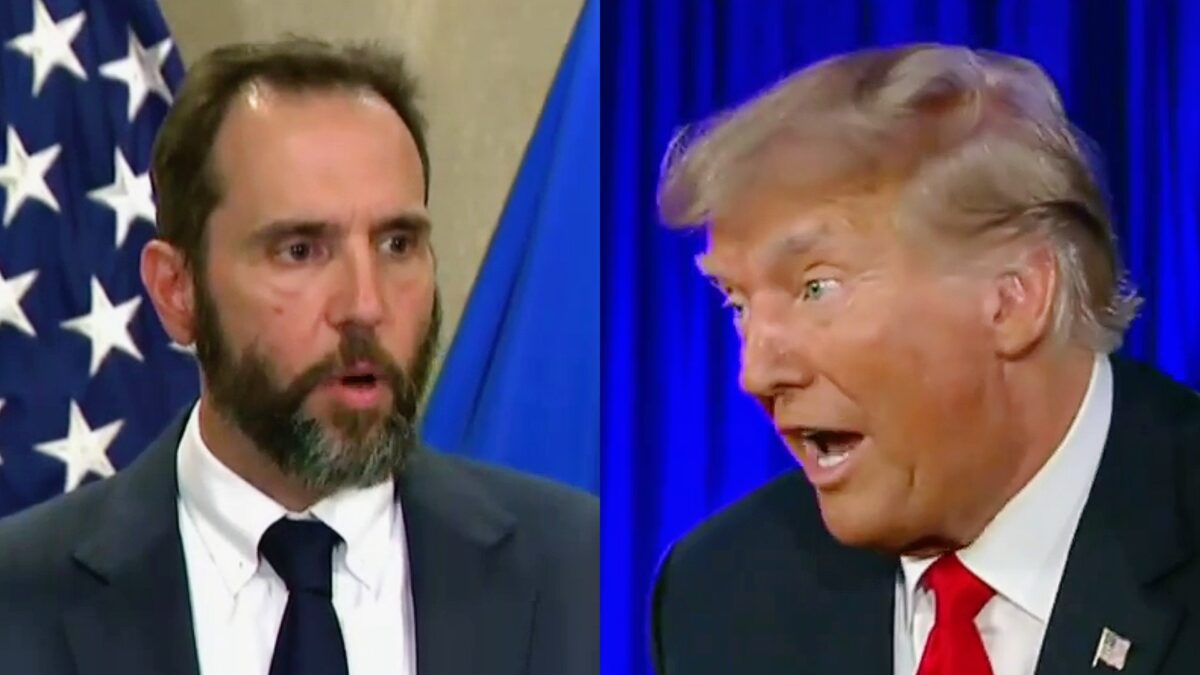
Jack Smith’s most scrutinized answer in his House Judiciary deposition was also his most precise. Asked whether he developed evidence that Donald Trump was responsible for the violence at the Capitol on January 6, Smith did not say yes or no. He said Trump caused the circumstances, exploited the violence once it began, and understood what it was doing for him.
That answer is now at the center of a political firestorm because the Justice Department released the full 255-page transcript of Smith’s closed-door testimony late on New Year’s Eve, a timing that guaranteed selective reading and rapid political framing. Within hours, Republicans and conservative commentators were declaring victory, portraying Smith’s words as a concession that Trump had effectively been given a pass.
House Judiciary Republicans, led by Chairman Jim Jordan, triumphantly declared “Game over.” Byron York argued that Smith’s answer should have been a simple “no,” and that anything short of that revealed the hollowness of the January 6 case. Washington Examiner’s Kaelan Deese framed Smith’s testimony as an admission that Trump never ordered the breach and was nonetheless “blamed anyway.”
Smith was never alleging that Trump ordered a mob to storm the Capitol or directed specific acts of violence. There is no evidence of that, and Smith acknowledged it plainly. It explains the boundaries of the case. It does not weaken it. Trump was charged with fraud, conspiracy, and obstruction because prosecutors believed those charges captured what the evidence supported beyond a reasonable doubt.
This is where these conservative critics seem to deliberately miss the point.
Smith was not asked to relitigate a theory he never advanced. He was explaining why he chose not to pursue incitement or violence-related charges. His answer was not a retreat. It was an explanation.
The crime, as Smith framed it, was not the riot itself. The riot was the leverage.
The violence disrupted the certification, intensified pressure on lawmakers and the vice president, and created an opening for schemes that were already underway. Smith’s theory does not depend on criminalizing speech at a rally or stretching First Amendment doctrine. It depends on showing that Trump recognized what the violence was accomplishing and chose to let it continue because it advanced his objective of stopping the transfer of power.
That distinction matters because a different narrative has lingered since January 6, reinforced by media shorthand. Many Americans believed the prosecution rested on proving Trump ordered the breach. Smith’s testimony narrows that misunderstanding rather than conceding responsibility. It shifts the focus from command to exploitation, from directing violence to using its effects.
York’s insistence that the “correct” answer was “no” only makes sense if the case required Trump to have directed the riot. It never did. Deese’s claim that Smith “blamed him anyway” similarly assumes that responsibility only exists where there is an explicit order. History, law, and common sense say otherwise.
Smith’s testimony also explains why Trump’s defense now has rhetorical force even as the legal theory remains intact. Trump can say that even his prosecutor admits he did not order the riot. That is politically potent. It does not negate the allegation that Trump knowingly used chaos he helped create.
Smith does not absolve Trump morally or factually. By saying Trump caused the conditions for violence and exploited it once it began, Smith assigns agency without charging the riot itself. The Stop the Steal rally that preceded the attack shows how those conditions were set.
Smith could not have answered the question differently without distorting the record. Saying Trump was responsible for the violence would have overstated the evidence and invited constitutional challenges. Saying Trump had nothing to do with it would have contradicted timelines, testimony, and the obstruction theory. Smith chose precision because he understood that this testimony would live on long after the case itself was over.
That is the more profound significance of the New Year’s Eve release. With criminal accountability off the table and Republicans preparing investigations of the investigators, this deposition freezes the federal government’s account of January 6 into the public record. York, Deese, and Jordan are not responding to a concession. They are racing to redefine that record before it hardens.
The result is not a walk-back. It is a clarification. The violence was instrumental, not central. Trump is accused of exploiting a crisis, not commanding a mob. The case is about power and process, not bloodshed.
This is an opinion piece. The views expressed in this article are those of just the author.
New: The Mediaite One-Sheet "Newsletter of Newsletters"
Your daily summary and analysis of what the many, many media newsletters are saying and reporting. Subscribe now!





Comments
↓ Scroll down for comments ↓