Trump Revives #Italygate — The Weirdest 2020 Election Conspiracy of Them All


(Photo by Andrew Leyden/NurPhoto via AP)
In the middle of a late-night online posting spree on Wednesday, President Donald Trump resurrected what may be the most bizarre conspiracy theory to emerge from the aftermath of the 2020 election: the idea that the vote was stolen in a globe-spanning covert operation involving Italian military satellites, U.S. intelligence agencies, and China.
Between posts declaring former President Barack Obama a “traitor” and inaccurate claims Walmart is shutting down in California, the president reshared a screengrab of an X post to his 11.6 million followers on Truth Social alleging that “Italian officials at [defense contractor] Leonardo SpA used military satellites to help hack U.S. voting machines, flipping votes from Trump to Biden using CIA-developed tools like Hammer and Scorecard.”
“China reportedly coordinated the whole operation,” the post claimed, while “the CIA oversaw it” and “the FBI covered it up.”
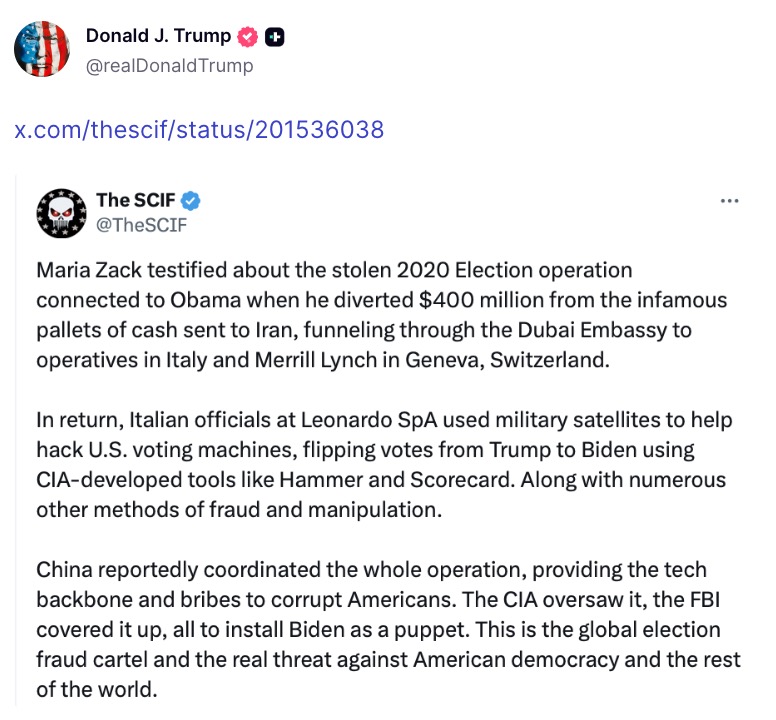
(Screengrab via Truth Social)
This particularly elaborate conspiracy theory, dubbed “Italygate,” is not new and was, in fact, mainlined from QAnon channels to staffers in the first Trump administration during the months between the 2020 election and former President Joe Biden’s inauguration, while Trump was pushing claims the election was “rigged.”
The story of how the theory came to find its way to the White House is itself a saga as strange as the theory and detailed thoroughly in ABC News correspondent Jonathan Karl’s 2021 book Betrayal: The Final Act of the Trump Show.
According to Karl, it was Virginia businesswoman Michele Ballarin, who presented herself as a wealthy intelligence insider, that first pushed the claims Italian military satellites had remotely altered U.S. voting machines. Ballarin, who also used the names Michele Roosevelt Edwards and Michele Lyn Golden — but also went by “the princess” — made contact with the National Security Council’s then-cybersecurity director Josh Steinman through intermediaries.
According to Karl, the pair did not meet in a secure briefing room, but a grocery store parking lot in Arlington, Virginia for a clandestine rendezvous that Steinman would call “one of the most bizarre experiences of his professional life.” There, she shared her claim, which the official dismissed to a colleague as “totally crazy.”
Yet by mid-December 2020, Karl continues, curiosity around Italygate had reached the Pentagon and senior officials, who were pressed to investigate claims that two men imprisoned in Italy had confessed to hacking the U.S. election using satellite technology.
Conspiracy theorists had fixated on one of those men, Arturo D’Elia, an Italian IT specialist previously charged over cyber intrusions involving a defense contractor. Italian authorities denied any connection between D’Elia and the election, and no evidence ever emerged tying him to altered vote totals.
Karl records that none other than Kash Patel, then-chief of staff to the acting defense secretary, and now the director of the FBI, pushed Pentagon officials and then-Defense Intelligence Agency director Lieutenant General Scott Berrier to pursue the claims on January 2, 2021,, seeking to urgently dispatch US defense personnel in Rome to interview the imprisoned Italians.
After examining the allegations, Karl adds, the agency’s director reported back that “the strange story was entirely untrue,” concluding that “neither prisoner had said anything at all about interfering with the election” and that their case was “entirely unrelated to anything remotely involving the 2020 US presidential election.”
That conclusion did little to kill the theory. Inside the White House, the conspiracy was taken seriously enough to generate emails, phone calls, and repeated requests for further review. As Karl documents, then chief of staff Mark Meadows pressed senior officials across the Pentagon, the Justice Department, and the intelligence community to continue examining the theory even after it had been internally dismissed.
Meadows’s emails, released by the House Oversight Committee in June 2021, included a December 27, 2020 letter addressed to “Illustrious Mr. President” and attributed to a man named Carlo Goria of a firm called USAerospace Partners — interestingly where Ballarin was CEO. The letter laid out the Italygate conspiracy, claiming the Italian defense company Leonardo SpA had “changed the US election result from President Trump to Joe Biden” by “using advanced military encryption capabilities.”
It continued to circulate online under the hashtag #ItalyGate. According to Karl, it also found a political advocate in Maria Strollo Zack, founder of the group Nations in Action, who became one of its most visible promoters and claimed she briefed Trump on the theory during a December 2020 dinner at Mar-a-Lago.
Zack’s organization later issued a press release alleging that votes had been switched “throughout America.” It was published on January 6, 2021 — the day of the US Capitol riot.
The sharing of these conspiracy theories comes the same day federal agents executed a search warrant Wednesday at the Fulton County Election Hub and Operations Center outside Atlanta as part of an investigation related to the 2020 election.
So now, in 2026, Trump’s evidence-free insistence that the election he lost to Biden was stolen and rigged against him shows no sign of fading. Whether the claim involves ballots, machines, satellites, or foreign intelligence agencies appears almost beside the point. What matters is the narrative itself, that defeat can always be explained away, and that any conspiracy, no matter how implausible, is useful so long as it keeps the underlying claim alive.
This is an opinion piece. The views expressed in this article are those of just the author.
New: The Mediaite One-Sheet "Newsletter of Newsletters"
Your daily summary and analysis of what the many, many media newsletters are saying and reporting. Subscribe now!








Comments
↓ Scroll down for comments ↓