Trump’s Call for the Nation to ‘Get On’ From Epstein Will Only Deepen Suspicion

AP Photo/Alex Brandon
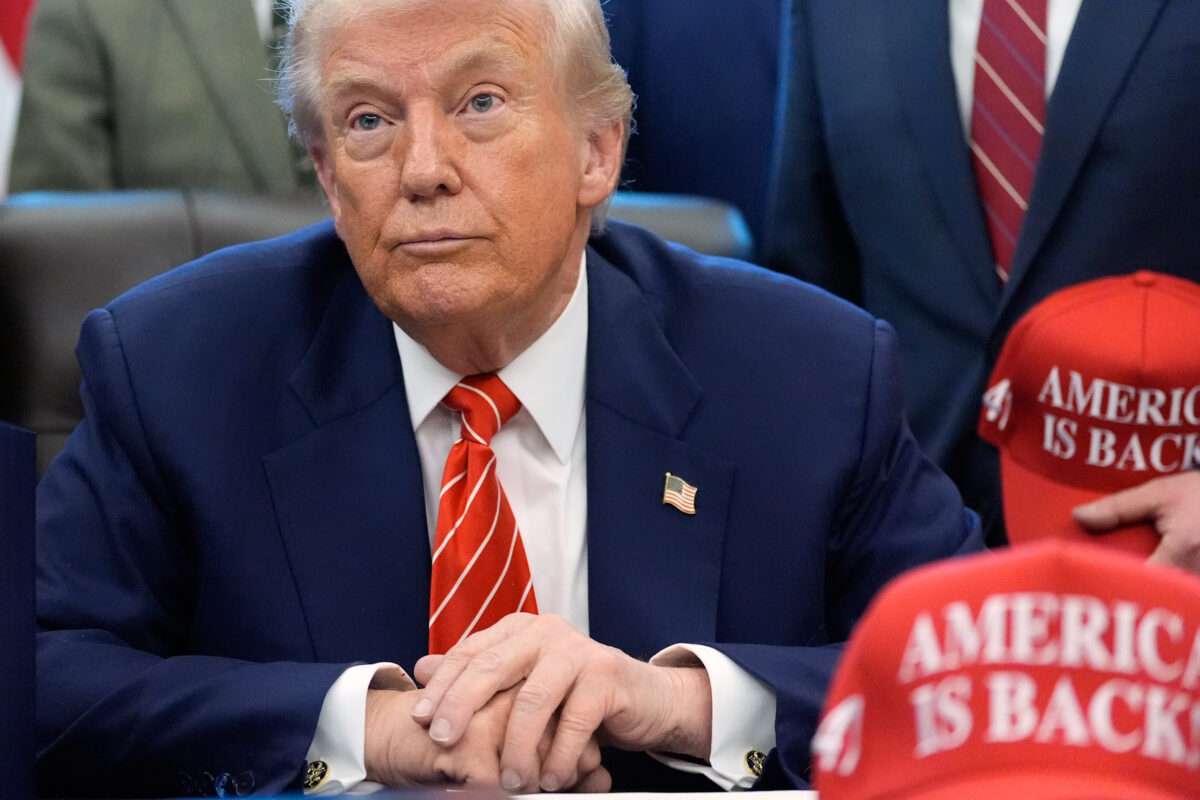
President Donald Trump’s confrontation with CNN’s Kaitlan Collins in the Oval Office was revealing not because of the personal insults, but because of the miscalculation it exposed — and the way his response is likely to produce the opposite of what he intended.
When pressed about the recent DOJ release of Epstein files and objections raised by Epstein survivors, Trump insisted the story was finished. For a politician who built his career on mastering narrative control, that instinct signaled a loss of touch.
The exchange came during a press availability following the signing of legislation ending the partial government shutdown. Collins asked Trump about the Justice Department’s latest Epstein file release and about survivors who objected to sweeping redactions, including entire witness interviews. Trump waved off the concern, claimed the documents exonerated him, and urged the country to “get on to something else” — specifically healthcare and “things that people care about.” When Collins pressed the point, Trump cut her off and attacked her personally, accusing her and CNN of dishonesty.
The significance of the moment revealed far less about Trump’s combative tone. It was his strategy, or lack thereof. He was trying to impose closure on a story structurally resistant to it, by his own doing.
Trump’s assertion that the Epstein files cleared him is not borne out by the release itself. The documents added scale, not resolution. The New York Times found Trump’s name mentioned more than 5,300 times across the Epstein files. That figure does not operate as a legal conclusion. It operates as saturation. In the political environment Trump helped build, volume confers meaning.
This is the bind Trump created for himself. For years, he trained supporters and critics alike to treat documents as repositories of hidden truth, redactions as signals of guilt, and official assurances as evidence of cover-up. Epstein fits perfectly inside that framework. It is document-heavy, institutionally compromised, morally grotesque, and unresolved. Trump cannot now ask the country to abandon interpretive habits he spent a decade reinforcing.
The Oval Office exchange demonstrated that contradiction in real time. Trump framed Epstein as a conspiracy against him and insisted the nation get on to something else. Collins redirected him to the survivors. Trump rejected the premise of the question altogether. That sequence revealed incompatibility, not temperament. A movement built on suspicion does not accept finality by decree.
Conservative media has tried to manage the problem through silence. Fox News has largely avoided the Epstein story, limiting exposure among Trump’s most loyal viewers. That strategy helps explain why the scandal has not fully attached to him yet. It does not resolve the underlying tension. The MAGA coalition was built on rejecting gatekeepers. When gatekeepers go quiet, the silence itself becomes suspect.
Pressure now converges from multiple directions. QAnon-adjacent believers read redactions and disappearing material as confirmation that crimes are being concealed. Trump critics read the same conduct as institutional protection of the powerful. Survivors and their lawyers accuse the DOJ of incompetence and cover-up, anchoring the controversy in ongoing harm rather than abstract intrigue. These are not parallel complaints. They reinforce one another. Each group, for different reasons, hears “get on to something else” as evidence that the story remains unfinished.
Trump has no obvious way to break this cycle, because he built it. Every dismissal becomes evidence of evasion. Every redaction becomes confirmation. The interpretive framework he weaponized against his enemies now applies to him, and it does not come with an off switch.
His Epstein problem is structural, narrative-driven. Evidence-proof.
In the Oval Office, he collided with that logic. The more he insists the nation get on to something else, the more he ensures it won’t.
This is an opinion piece. The views expressed in this article are those of just the author.
New: The Mediaite One-Sheet "Newsletter of Newsletters"
Your daily summary and analysis of what the many, many media newsletters are saying and reporting. Subscribe now!








Comments
↓ Scroll down for comments ↓