House Democrat Files Motion to Remove Tarp from Kennedy Center, Blasting Trump Admin’s ‘Petty Act of Defiance’

AP Photo/Rahmat Gul
Rep. Joyce Beatty (D-OH) filed a motion seeking to remove the tarp from the front of the Kennedy Center and blasting President Donald Trump’s administration for its “petty act of defiance” of previous court orders.
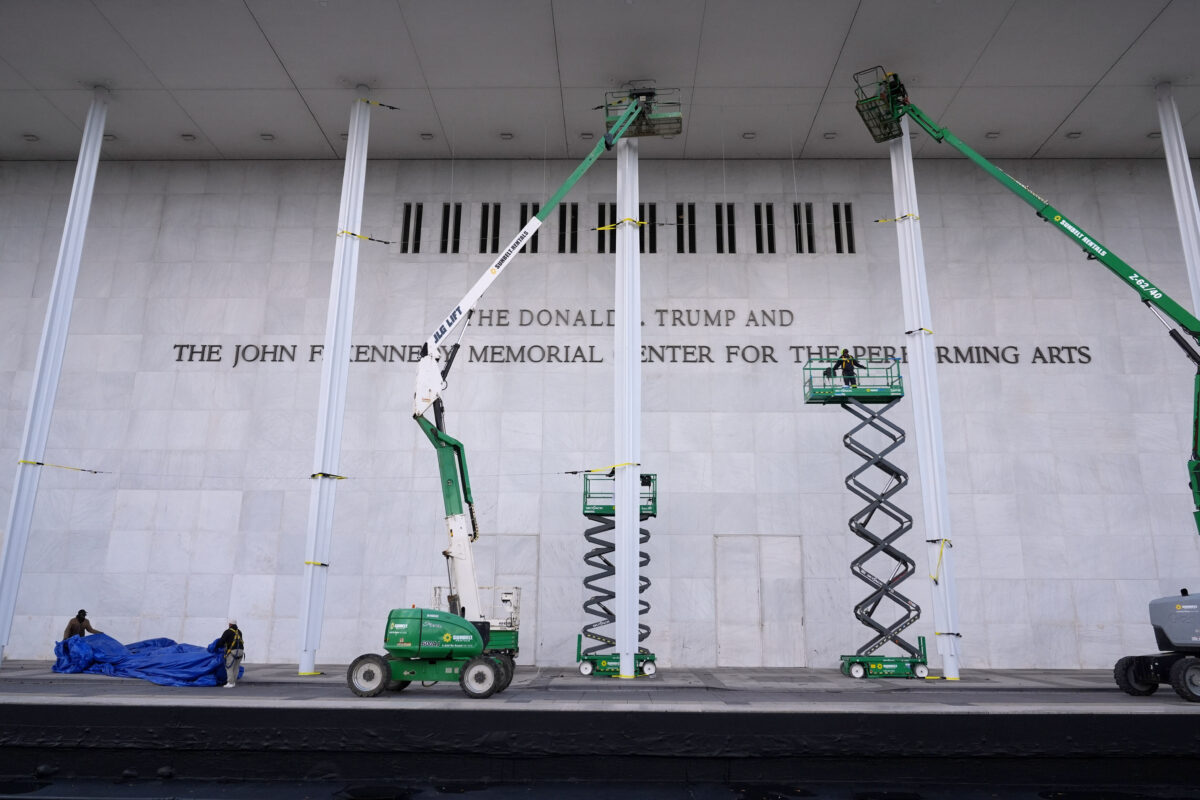
Shortly after his second inauguration, Trump appointed himself to the board for the John F. Kennedy Memorial Center for the Performing Arts, and added several of his allies to the board as well, who then named him chair. The new Trump-controlled board voted to change the name to add the president’s name, and the center’s website, social media, and other digital branding were updated to say “The Trump Kennedy Center” and his name was added to the building’s façade.
Beatty is a Kennedy Center board member and objected to the renaming. She filed a lawsuit in late December challenging the “illegal renaming,” arguing that “[b]ecause Congress named the center by statute, changing the Kennedy Center’s name requires an act of Congress.” She has been represented by a legal team led by Norm Eisen, along with the organization he co-founded, Democracy Defenders Action, and the Washington Litigation Group.
Last month, Judge Christopher Cooper, an Obama appointee of the U.S. District Court for the District of Columbia, ruled in Beatty’s favor, ordering Trump’s name to be removed from the Kennedy Center by Friday, June 12.
On the day of the deadline, Trump filed a motion seeking a stay of the removal of his name, which Cooper denied, and Trump then appealed to the U.S. Court of Appeals for the District of Columbia Circuit, getting denied once again.
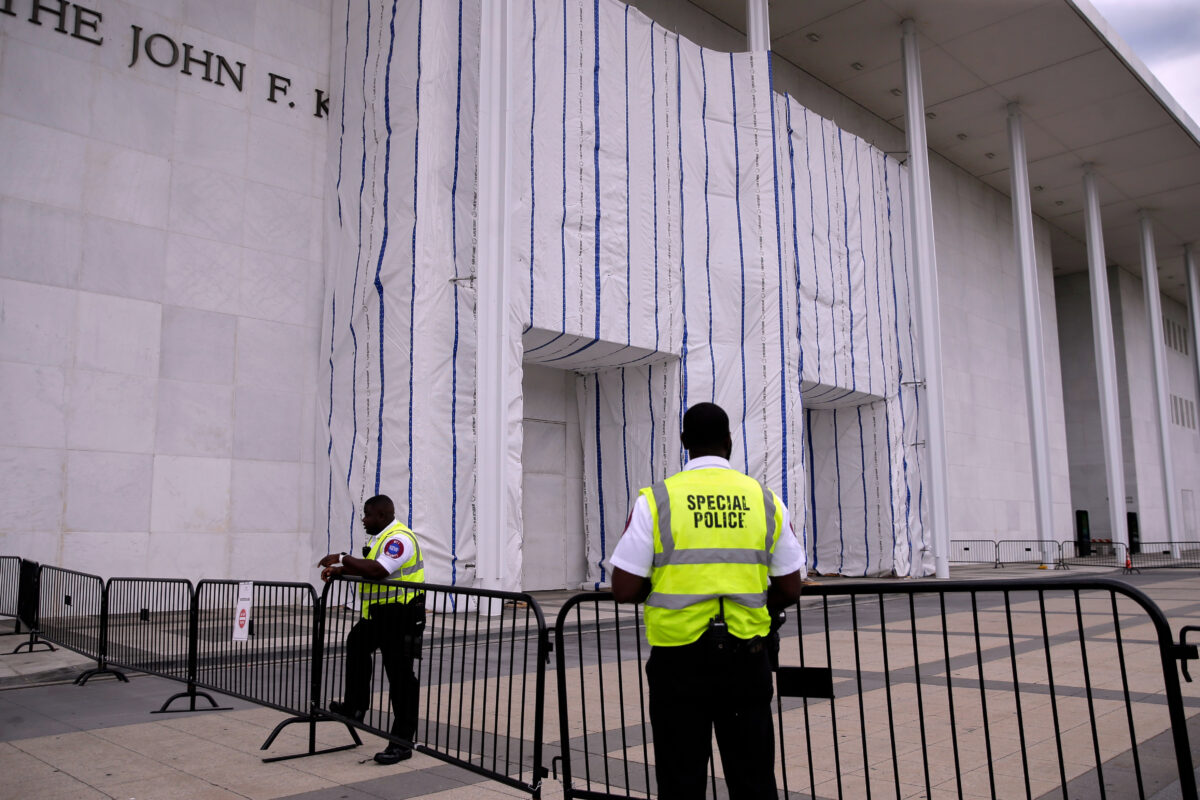
Workers spent hours slowly putting up scaffolding in front of the Kennedy Center to reach the letters. Several commentators noted that when the letters were installed back in December, cherry pickers were used to do the job much quicker (see photo below), leading to speculation the scaffolding was ordered to create additional delays and give Trump’s appeals more time.
AP Photo/Jacquelyn Martin
The midnight deadline came and went without a single letter being taken down, and Trump filed another request for a 12-hour delay, citing the “thunderstorms in the District of Columbia that presented safety concerns for workers.”
The real reason for the scaffolding became clear later that evening when workers began hanging up large tarps that concealed their work removing the letters in Trump’s name and blocked the view of the Kennedy Center façade afterwards.
Beatty’s latest motion threw some sharp rhetorical punches at the Trump administration. Part of the motion dealt with Trump’s plan to close the Kennedy Center for two years, which was also blocked by Cooper in a previous order, blasting it as a “plan to turn the Kennedy Center into a lifeless husk by refusing to take any steps to maintain the Center’s operations,” and one that “will effectively close the Center as a performing arts venue come July 5, 2026—contrary to the Court’s preliminary injunction order.”
Regarding the renaming, Beatty’s motion pointed out that she had “repeatedly requested clarity” regarding compliance with the order to remove Trump’s name, but the defendants had “refused to provide any explanation whatsoever,” even though the president and other administration officials had spoken to the press.
The motion went into detail complaining about the tarp, which is “shield[ing] the work from public view” and still “inexplicably remains” up, along with the scaffolding.
“Indeed, it appears that the tarp will be there for the long term,” wrote Beatty’s attorneys, noting that the workers had “fashioned two doorways in the structure to permit pedestrian access underneath the structure, and the entire assemblage appears to be semi-permanent,” and the tarp “largely obscures John F. Kennedy’s name on the front portico.”
“This latest development is a transparent effort to frustrate a return to the status quo that existed prior to the Board’s unlawful vote to rename the Kennedy Center on December 18, 2025,” the motion argued. The attorneys further scoffed at the defense claims that the scaffolding and tarp were needed to “address maintenance needs of the marble and soffit panels,” noting that the “scaffolding appears to be approximately twenty feet below the soffits” and there has not been any explanation provided about what the maintenance needs actually are.
“Instead, Defendants appear to be actively undermining the restoration of the Kennedy Center’s name, in a petty act of defiance,” the lawyers wrote, and then took some swipes at the president’s “ego” in wanting his name on landmarks. “In addition to raising concerns about compliance, willfully sabotaging Kennedy Center’s iconic façade to assuage Defendants’ vanity or massage broken egos is a clear breach of fiduciary duty.”
The motion also highlighted the “additional context” of Trump’s previous motion in which it was claimed that the delays were due to the “thunderstorms,” arguing that the delays were just excuses to put up the tarp to “shield the work from public scrutiny,” because “when Defendants finally got around to removing the letters in the early hours of June 13, 2026, the letters came off by hand.”
If the Trump administration had not been “focused on constructing their bizarre and unnecessary privacy screen on the night of June 12, 2026, the letters could have been removed before the Court’s ordered deadline,” the motion argued.
The motion was especially pointed in its attacks against a new argument the administration made during its last-minute appeals to block Trump’s name from being removed, that a new corporate entity had been created that required Trump’s name to remain in order to keep any donations made to the center.
This was a “deeply concerning” development, the motion argued, because the creation of this entity itself was in violation of Cooper’s previous orders. This scheme was a threat “to sabotage the Kennedy Center by invoking a poison pill—apparently of their own making—that would directly rob the Center of funding if they are not permitted to continue to violate the law,” and “this scorched earth tactic—i.e., holding the trust itself hostage in a bid to violate trust’s terms—is a clear breach of fiduciary duty,” the motion added.
New: The Mediaite One-Sheet "Newsletter of Newsletters"
Your daily summary and analysis of what the many, many media newsletters are saying and reporting. Subscribe now!









Comments
↓ Scroll down for comments ↓