Jack Smith Smacks Down Trump Team’s ‘Pervasively False’ Storyline In Blistering Filing For Espionage Act Case

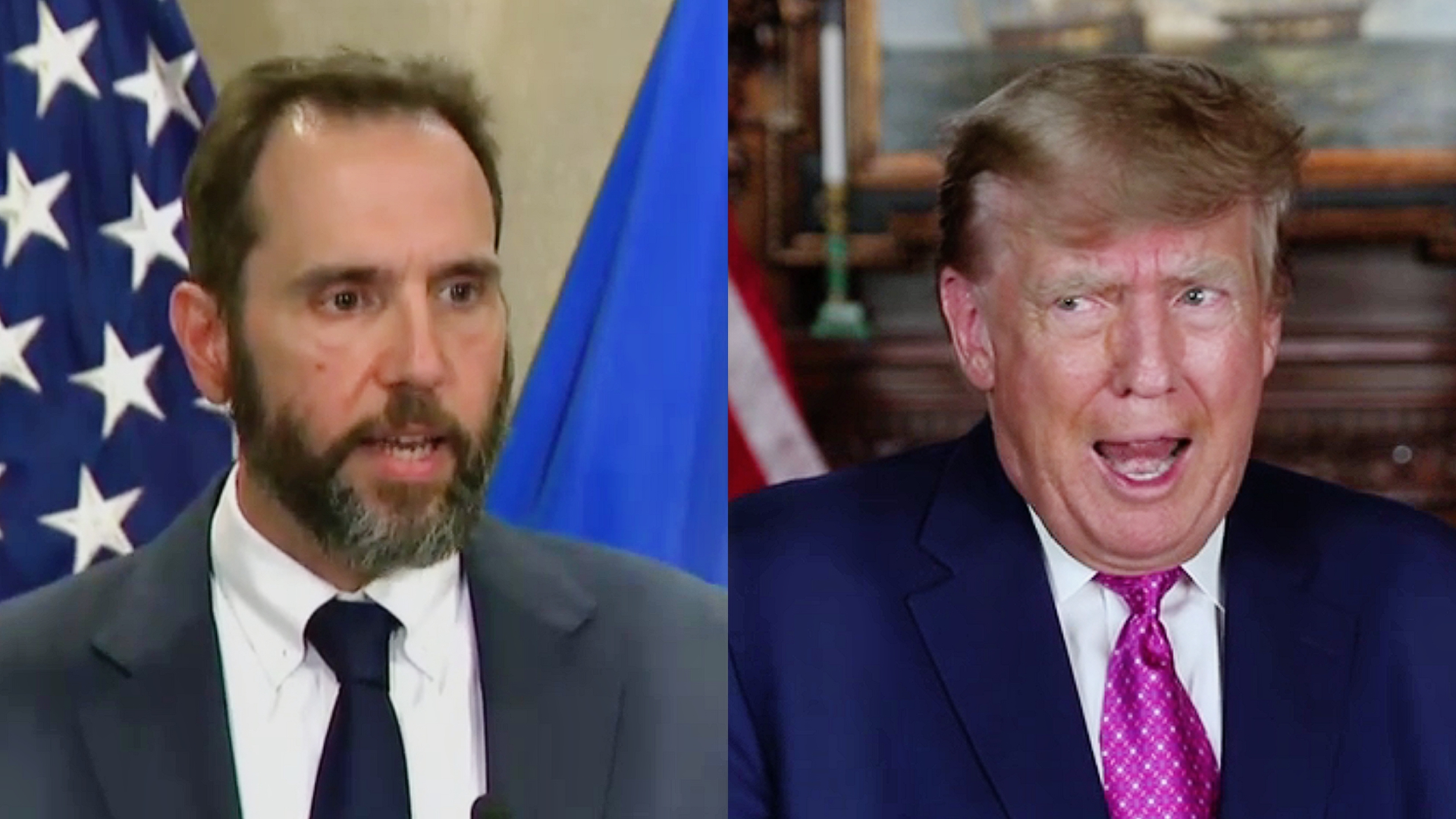
Special Counsel Jack Smith thoroughly smacked down ex-President Donald Trump’s “pervasively false” storyline on the Espionage Act case in a blistering filing Friday.
In August of 2022, the FBI raid on Trump’s Mar-a-Lago resort home kicked off a stream of invective and threats against the FBI and eventually led to Trump’s arrest and arraignment on 37 counts related to violations of the Espionage Act. Critics have accused Judge Aileen Cannon — a Trump appointee — of slow-walking the case.
But Smith and his team continue to soldier on, and in a new filing, took a few minutes to smack down the distorted version of the case that Trump and his team have spun since the raid.
In a filing responding to a slew of Trump motions, Smith wrote, “Before turning to those arguments, it is necessary to set the record straight on the underlying facts that led to this prosecution because the defendants’ motion paints an inaccurate and distorted picture of events.”
In his introduction to the 15-page debunking section, Smith wrote:
The defendants rely on a pervasively false narrative of the investigation’s origins. ECF No. 262 at 5-6. Their apparent aim is to cast a cloud of suspicion over responsible actions by government officials diligently doing their jobs. The defendants’ insinuations have scant factual or legal relevance to their discovery requests, but they should not stand uncorrected. Put simply, the Government here confronted an extraordinary situation: a former President engaging in calculated and persistent obstruction of the collection of Presidential records, which, as a matter of law, belong to the United States for the benefit of history and posterity, and, as a matter of fact, here included a trove of highly classified documents containing some of the nation’s most sensitive information. The law required that those documents be collected. And the record establishes that the relevant government officials performed their tasks with professionalism and patience in the face of unprecedented defiance.
To develop its counternarrative, the defendants cherry-pick exhibits and selectively quote from documents that the Government itself produced in discovery, putting a nefarious gloss on innocuous events. But selective quotations from documents, coupled with speculative leaps, do not make for genuine factual disputes—much less, contrary to the defendants’ claim (ECF No. 262 at 5), the necessity for an evidentiary hearing. The storyline that the defendants seek to develop is contradicted by the full text of the documents they cite and by documents they ignore. The account that follows—which relies entirely on documents produced in discovery—corrects the misimpressions that the defendants create.’
In the following 15 pages, Smith goes through the entire narrative of the case, then sums things up in a subheading aptly entitled “Summing Up”:
As the exhibits and an accurate timeline attest, the defendants’ narrative overlooks the fact that various federal agencies confronted, and appropriately responded to, an extraordinary situation resulting entirely from the defendants’ conduct. NARA first sought over a protracted period to retrieve documents from Trump’s PRA representatives, whose responses were dilatory, shifting, and incomplete. As NARA attempted to carry out its statutory responsibilities from 2021 into 2022, highly classified documents sat in a ballroom, bathroom, office space, and a basement storage room at a social club traversed by thousands of members, employees, and guests. NARA rightly involved other government agencies that had equities and authorities that it did not, as necessary to navigate an unprecedented situation. The White House Counsel’s office became involved because of the need to consult its personnel about missing Trump Administration Presidential records. DOJ became involved because of the Attorney General’s authority to retrieve records through court action and later to assess whether a criminal inquiry was warranted—all well outside of NARA’s archival function. And the Intelligence Community became relevant once the alarming fact emerged that Trump’s boxes contained classified records that he had no authority to keep, let alone store in boxes at his residence. Where the defendants perceive “bias,” “weaponize[d]” use of authorities, and a “sham referral,” all attributed to an undifferentiated “Biden Administration,” ECF No. 262 at 5-9, the record shows only different government agencies, with specific portfolios and responsibilities, at work to solve an increasingly vexing and concerning problem. That is hardly surprising, and it in no way, shape, or form supports the hyperbolic claim of “politically motivated operatives” launching a “crusade against President Trump.” Id. at 1. The defendants’ legal problems are solely of their own making.
Read the full filing here.