Trump and Mamdani’s ‘Lovefest’ Exposes the Media’s Broken Script

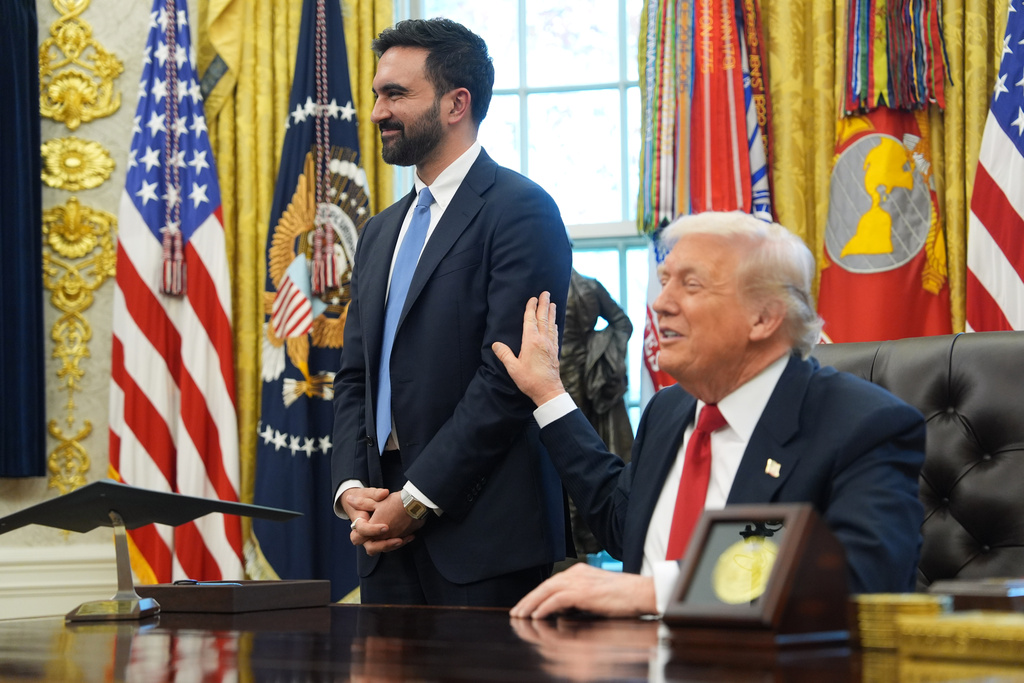
(AP Photo/Evan Vucci)
In the low hum of a White House press spray, President Donald Trump and New York City mayor-elect Zohran Mamdani stood shoulder to shoulder, smiling like co-hosts rather than rivals. Trump called him a “good guy.” Mamdani laughed when reporters asked whether he still thought the president was a fascist; Trump even jumped in and joked, “You can just say yes.”
For weeks prior, their relationship had been framed as open political warfare. Trump had branded Mamdani a communist, threatened to cut off federal funding, and even floated deporting him. Mamdani had called Trump a fascist and despot and vowed to “Trump-proof” New York. So when the two men suddenly appeared as pragmatic partners, a lot of people—especially in the political media—looked genuinely stunned.
The quick, easy takeaway was that Trump finally admitted what many suspected: his most radioactive campaign invective was performance, not deep personal animus. He shrugged the whole thing off as “things we said during the campaign,” the rhetorical equivalent of brushing lint from his jacket.
That’s the obvious lesson. It’s also the least interesting one.
The more revealing thing about the Trump–Mamdani photo-op wasn’t that Trump dropped the act. It was how visibly the media’s narrative framework buckled when Mamdani refused to keep playing his assigned role.
Political journalism, particularly where Trump is concerned, tends to operate like a casting department. The president is the villain; whoever opposes him is cast as either a moral hero or a tragic naïf. Conflict isn’t just covered; it’s curated. Entire segments, packages, and chyrons are built on the premise that every insult is sincere and every feud existential.
To be fair, “the media” is not a single hive mind. Some outlets handled the meeting in a straightforward, almost boring way—wire-style summaries stressing that an ideologically opposed president and mayor-elect found common ground on crime and affordability. But in the takes economy—cable, columns, and social video—the script was very different. Write-ups called it a “White House lovefest,” and others lingered on how “those hoping for a brawl” were left disappointed when Trump lavished praise instead of punishment. That’s not a neutral description; that’s a narrative investment suddenly going sideways.
And that’s the hinge of the story: the surprise was not that Trump could pivot from bomb-thrower to backslapper. He does that all the time. The surprise was that Mamdani declined to stage the confrontation that many in the press had already written into their rundowns.
It’s worth asking why he did that.
Part of the answer is basic governance. Mamdani is about to take over a city that depends heavily on federal money and regulatory cooperation. After weeks of Trump threatening to starve New York of funds if Mamdani won, there was obvious value in being seen as someone who can sit across from the president and talk business like an adult. The friendlier the body language, the easier it is—politically and bureaucratically—to claw back some of what those threats put at risk.
There’s a coalition angle too. Mamdani comes out of the Democratic Socialist and DSA-aligned left, where there is a constant tension between movement posture and governing reality. If he had turned the Oval Office spray into a televised rebuke—refusing a handshake, restating that Trump is a fascist, re-litigating every insult—he would have thrilled a segment of his base but risked confirming the caricature Trump and his allies have worked hard to build: the rigid ideologue who would rather perform resistance than get results.
By treating Trump like a transactional actor instead of metaphysical evil, Mamdani pulled off a tricky double move. He didn’t apologize for his earlier language, which keeps his ideological bona fides intact, but he also signaled to the broader city that he’s willing to swallow some theater to secure material benefits. That’s not self-evident; it’s a deliberate calculation. In other words, he didn’t just refuse to play the media’s part for him—he wrote his own: the pragmatic leftist who can sit with a hostile president and still walk out with something for New Yorkers.
That kind of strategic flexibility stands in sharp contrast to how the press operates. Political reporters have spent nearly a decade documenting Trump’s split-screen persona—the off-camera charmer alongside the on-camera arsonist. But in practice, much of the coverage still treats the arson as the only real part. Each slur is packaged as evidence of a deep moral truth, each feud as another turn in an epic saga about American democracy.
There are reasons for that. If Trump’s rhetoric is treated as sincerely apocalyptic, then the press gets to cast itself as a kind of moral witness. If the insults are pure id, then every tweet warrants a push alert. If the animus is absolute, then every détente becomes a twist in a prestige drama. There’s a built-in reward for over-reading his language and under-reading his showmanship.
The problem is that Trump occasionally blows up that framing by being explicit about the performance. In this case, he waved away his own “communist” and “nutjob” talk with a smile and a line about campaigns. When the star of the show keeps saying it’s a show, it becomes harder for the critics to insist it’s scripture.
The Mamdani moment threw that tension into sharp relief. Trump made the performance obvious. Mamdani treated it as obvious. And a sizable chunk of the commentary world reacted as though reality had broken in on their storyline.
None of this excuses Trump’s past language. Performance or not, his words have real-world effects: they legitimize bigotry, normalize authoritarian flirtations, and embolden people who hear them as literal marching orders. The damage isn’t lessened by the fact that he’s half-winking his way through it.
But if political media can’t hold two truths at once—that Trump is both dangerous and theatrical, both reckless and opportunistically flexible—they will keep getting whiplash every time he pivots from threat to charm.
The same goes for how we talk about his opponents. As long as the coverage keeps forcing everyone into a binary—hero or stooge, resister or sellout—it will miss the more interesting, and more honest, story: that a figure like Mamdani is trying to navigate between movement identity and municipal responsibility under a president who thrives on collapsing that distinction.
The neat way to end this would be to say Trump exposed the performance and Mamdani exposed the press. It sounds good. It’s also too tidy. The machinery that produced this moment is still humming: the outrage incentives, the narrative casting, the base politics that reward theatrical purity over compromise.
The harder, more uncomfortable question is what happens the next time this script gets rolled out. Does political journalism treat this meeting as a lesson and adjust—covering Trump more like an entertainer with power than a villain in a melodrama, and covering someone like Mamdani as a politician with multiple audiences rather than a one-note foil? Or does everyone simply reset, reload the talking points, and wait for the next imagined showdown that dissolves into an awkwardly polite handshake?
If recent history is any guide, the answer is bleak. The show goes on. The incentives don’t change. And every once in a while, when the actors decide to play a different scene, you can still see the people holding the script blinking in confusion.
This is an opinion piece. The views expressed in this article are those of just the author.
New: The Mediaite One-Sheet "Newsletter of Newsletters"
Your daily summary and analysis of what the many, many media newsletters are saying and reporting. Subscribe now!






Comments
↓ Scroll down for comments ↓