‘We’ve Already Won’: The Iran War’s ‘Mission Accomplished’ Moment Has Quickly Arrived

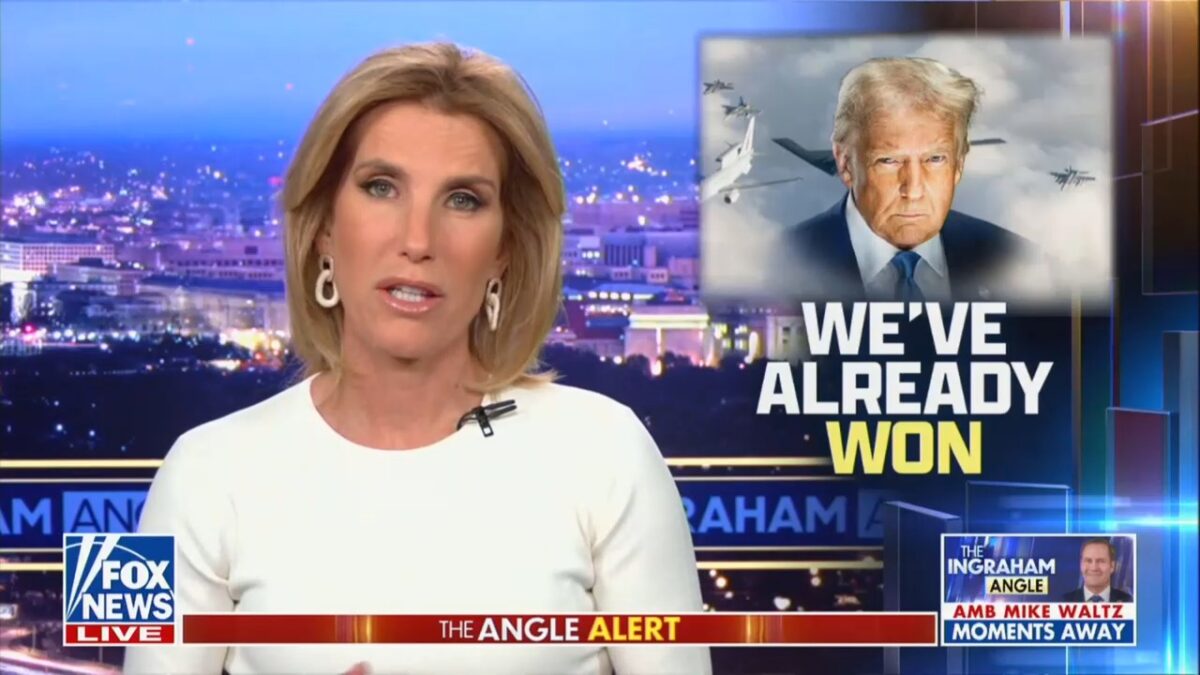
Within 72 hours of the opening strikes on Iran, Fox News ran a chyron declaring “WE’VE ALREADY WON.”
Laura Ingraham argued Monday that objections to the campaign didn’t “withstand serious scrutiny.” On Tuesday evening, Senator John Kennedy, fresh from a classified briefing, told Sean Hannity the same thing: “We’ve already won.” Vice President JD Vance has said it before the strikes and after — there is “no chance” this becomes a prolonged conflict. Maybe. But that is also what people said in May 2003.
To be clear about something first: credit where it’s due. Ayatollah Ali Khamenei was a genuinely brutal ruler. His security forces crushed protests, executed dissidents, and restricted political and personal freedoms for millions of Iranians over decades. The speed and precision of the strike that killed him reflect real military capability and serious intelligence work. The celebrations among Iranians who lived under his boot are understandable and legitimate, and no honest assessment of this moment should pretend otherwise. Killing Khamenei mattered. The question is whether it’s the whole story — and it isn’t.
The instinct to declare early victory is not new, and its consequences are not abstract. On May 1, 2003, George W. Bush landed on the USS Abraham Lincoln in a flight suit, stood before a banner reading “Mission Accomplished,” and declared that major combat operations in Iraq were over. But the mission had not been accomplished. The war would continue for another eight years, cost nearly 4,500 American lives, and reshape the Middle East in ways no one in that administration anticipated or fully acknowledged.
That moment became shorthand for something specific: the premature declaration of victory, the image that outran the facts, and a press that amplified the pageantry before asking the harder questions. The banner is back. It just lives on a chyron now.
On Wednesday morning, Defense Secretary Pete Hegseth stood at a podium and said the quiet part out loud: “This is not a Mission Accomplished situation.” The denial is itself a tell. When the Pentagon feels compelled to preemptively argue against a twenty-year-old analogy, the analogy has already landed. Hegseth laid out specific objectives — destroy Iran’s missile and drone infrastructure, annihilate its Navy, sever the nuclear pathway — which is at least more defined than “peace.” Those objectives are now on the record and can be measured. Whether the press treats them as a checklist or a talking point will say something about the quality of the coverage that follows.
What made Iraq a quagmire wasn’t the opening strike. It was everything that followed — the absence of a stable successor structure, the fragmentation of existing institutions, the chaos that filled the vacuum. President Donald Trump campaigned explicitly against that kind of open-ended entanglement, and a genuine cross-section of Americans — from the antiwar left to MAGA isolationists — took him at his word. That coalition has reasonable grounds to ask whether removing Khamenei is the mission or merely the opening move of something considerably larger and less defined.
The early evidence suggests the latter. Iran’s response has not looked like a defeated military standing down. Missiles have come in smaller packets, roughly every thirty minutes, across multiple fronts — a pattern analysts suggest may reflect elements of Iran’s forces operating without tight centralized direction.
In a country with advanced missile forces and a live nuclear program, that kind of command fragmentation is not a reassuring development. It raises the possibility of US-Israeli miscalculation and unintended escalation, not because anyone wants wider war, but because degraded chains of command make it harder to stop. Meanwhile, Kuwait shot down three American F-15s in what the Pentagon is calling a friendly fire incident. Six U.S. service members are dead. Secretary of State Marco Rubio is warning that the next phase will be “even more punishing.” That is not the profile of a finished operation.
The political framing will move faster than these realities, and it will sort predictably along partisan lines — deterrence restored on one side, reckless escalation on the other. Neither lane addresses the central question, which is who actually consolidates power inside Iran now that its top leadership has been decapitated.
That question matters enormously, and the early answer is not encouraging. Iran has reportedly chosen Mojtaba Khamenei — the son of the man just killed — as its new supreme leader, selected under pressure from the IRGC. He has never held elected office, has virtually no public profile, and is known primarily for his behind-the-scenes ties to the Revolutionary Guards. The regime didn’t reach for a reformer or a technocrat. It reached for the nearest available Khamenei. That is not a strategic transformation. That is a dynasty doubling down — and it suggests the apparatus that ran Iran under his father intends to keep running it under the son, with the IRGC firmly in the driver’s seat.
The instability also carries consequences that extend well beyond the region. Roughly a fifth of the world’s oil flows through the Strait of Hormuz. Insurance markets have already recalibrated tanker risk. Energy markets respond quickly to disruption in that corridor, and higher crude prices move into gasoline prices and inflation expectations with little delay. Strategic shock abroad reaches American households directly and quickly, which means the economic story of this conflict is already beginning, whether cable news is covering it or not.
There is also the nuclear question, which deserves more serious attention than it is currently receiving. If leadership struggles intensify and authority becomes contested, safeguarding enriched material and sensitive facilities grows considerably more complicated. Nuclear security depends on clear lines of institutional responsibility. Any ambiguity at the top introduces risks whose consequences extend far beyond the current exchange of missiles — and those risks don’t come with missile trails to replay in slow motion.
Trump has pledged that bombing will continue as long as necessary to achieve peace. That is an understandable aspiration attached to an undefined endpoint. Peace can mean deterrence restored, regime collapse, negotiated settlement, or capitulation, and each carries entirely different implications for how long American forces remain engaged and at what cost. Sustained military action tied to a broad objective demands clarity about what success actually looks like — and a press corps that has already accepted the “we’ve already won” frame is poorly positioned to demand that clarity.
Iran continues to launch missiles. A friendly fire incident has already downed American aircraft. Hardline figures are positioning for succession. Energy markets are adjusting. Nuclear custody questions remain unresolved. The symbolic story of this moment is powerful and genuinely worth telling. But it is not the same as the structural story, and the gap between them is where the actual stakes of this conflict live. We have seen what happens when that gap goes unexamined.
The “Mission Accomplished” banner eventually came down from the Abraham Lincoln. The war, which was meant to end, lasted another eight years. The press that amplified the moment moved on, but the soldiers didn’t.
This is an opinion piece. The views expressed in this article are those of just the author.
New: The Mediaite One-Sheet "Newsletter of Newsletters"
Your daily summary and analysis of what the many, many media newsletters are saying and reporting. Subscribe now!







Comments
↓ Scroll down for comments ↓