Sen. Tom Cotton Calls Slavery ‘The Necessary Evil Upon Which The Nation Was Built’

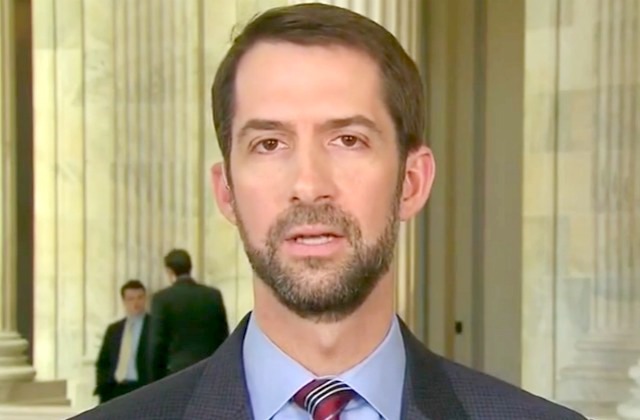
Sen. Tom Cotton (R-AR) raised eyebrows with comments that were published in the Arkansas Democrat Gazette on Sunday, calling slavery “the necessary evil upon which the union was built.”
Cotton’s remarks came in the context of an interview regarding a bill he filed that would prevent federal tax dollars from being used to teach the “1619 Project,” a research project, podcast series, and accompanying curriculum that was developed by Nikole Hannah-Jones for The New York Times Magazine. The date refers to the year in which the first slaves from Africa were brought to colonial America, and the project seeks “to reframe American history by considering what it would mean to regard 1619 as our nation’s birth year.”
The 1619 Project won praise for describing how slavery’s legacy continues to affect present-day America, and Hannah-Jones won the Pulitzer Prize for her work. However, it was also subject to criticism as “historical revisionism” for some of its assertions, primarily the claim that the American Revolution was primarily fought to preserve slavery. Leslie M. Harris, who had served as a fact-checker for the project, was among several prominent historians who “vigorously disputed” this claim, as she wrote in an op-ed at Politico.
Cotton’s bill, the Saving American History Act of 2020, labels the 1619 Project as “a distortion of American history,” and would cut off federal professional development funds from any school district that teaches the project’s curriculum, as well as reducing other federal funding in the amount estimated for that district’s “cost associated with teaching the 1619 Project, including in planning time and teaching time.”
Federal funds that serve low-income or special-needs students would not be changed.
In his interview with the Arkansas paper, Cotton called the 1619 Project “left-wing propaganda,” “factually, historically flawed,” and “revisionist history at its worst.”
Cotton noted that curriculum decisions were mostly decided at the local and state level, and his bill did not ban the 1619 project’s materials from being taught, it just refused to fund them if they did so.
“[I]f local left-wing school boards want to fill their children’s heads with anti-American rot, that’s their regrettable choice,” said Cotton. “But they ought not to benefit from federal tax dollars to teach America’s children to hate America.”
“It won’t be much money,” he pointed out. “But even a penny is too much to go to the 1619 Project in our public schools. The New York Times should not be teaching American history to our kids.”
Cotton spoke at length about the core premise of the 1619 Project. “The entire premise of the New York Times’ factually, historically flawed 1619 Project,” he said, “is that America is at root, a systemically racist country to the core and irredeemable. I reject that root and branch.”
“America is a great and noble country founded on the proposition that all mankind is created equal,” Cotton continued. “We have always struggled to live up to that promise, but no country has ever done more to achieve it.”
Cotton also addressed how he believes slavery should be taught:
In the interview, Cotton said the role of slavery can’t be overlooked.
“We have to study the history of slavery and its role and impact on the development of our country because otherwise we can’t understand our country. As the Founding Fathers said, it was the necessary evil upon which the union was built, but the union was built in a way, as Lincoln said, to put slavery on the course to its ultimate extinction,” he said.
Instead of portraying America as “an irredeemably corrupt, rotten and racist country,” the nation should be viewed “as an imperfect and flawed land, but the greatest and noblest country in the history of mankind,” Cotton said.
Cotton got some backlash on Twitter for the interview, including directly from Hannah-Jones.
If chattel slavery — heritable, generational, permanent, race-based slavery where it was legal to rape, torture, and sell human beings for profit — were a “necessary evil” as @TomCottonAR says, it’s hard to imagine what cannot be justified if it is a means to an end. https://t.co/yScNxPq6ds
— Ida Bae Wells (@nhannahjones) July 26, 2020
So, was slavery foundational to the Union on which it was built, or nah? You heard it from @TomCottonAR himself.
— Ida Bae Wells (@nhannahjones) July 26, 2020
Wait, if Cotton thinks slavery was essential in creating American society, the sine qua non without which America would not be America, then isn’t he agreeing with the 1619 project? https://t.co/YglaKIDG9K
— Jeet Heer (@HeerJeet) July 26, 2020
“The 1619 Project is left-wing propaganda. It’s revisionist history at its worst.”
I would love to know what @TomCottonAR would cite as an example of ‘revisionist history at its best.’ https://t.co/Pm4IbSwiAN
— Kevin M. Levin (@KevinLevin) July 26, 2020
These writers are so clunky. Having a guy named Cotton defend slavery in 2020 is just hackneyed.
— Joshua Holland ? (@JoshuaHol) July 26, 2020
If I wrote the screenplay for a political satire in which a politician named “Tom Cotton” called slavery a “necessary evil,” it would be blasted (by me, among others) as shallow lefty claptrap. And yet here we are.
— Christopher Orr (@OrrChris) July 26, 2020
The Arkansas senator responded, arguing that his critics were taking his comments out of context.
This is the definition of fake news.
I said that *the Founders viewed slavery as a necessary evil* and described how they put the evil institution on the path to extinction, a point frequently made by Lincoln. https://t.co/SaWTTlMO7w
— Tom Cotton (@TomCottonAR) July 26, 2020
More lies from the debunked 1619 Project.
Describing the *views of the Founders* and how they put the evil institution on a path to extinction, a point frequently made by Lincoln, is not endorsing or justifying slavery.
No surprise that the 1619 Project can’t get facts right. https://t.co/nLsb73X3Gi
— Tom Cotton (@TomCottonAR) July 26, 2020
Read the full interview at the Arkansas Democrat Gazette.
New: The Mediaite One-Sheet "Newsletter of Newsletters"
Your daily summary and analysis of what the many, many media newsletters are saying and reporting. Subscribe now!







Comments
↓ Scroll down for comments ↓