Supreme Court Sides With Republican Challenge to Campaign Finance Rules

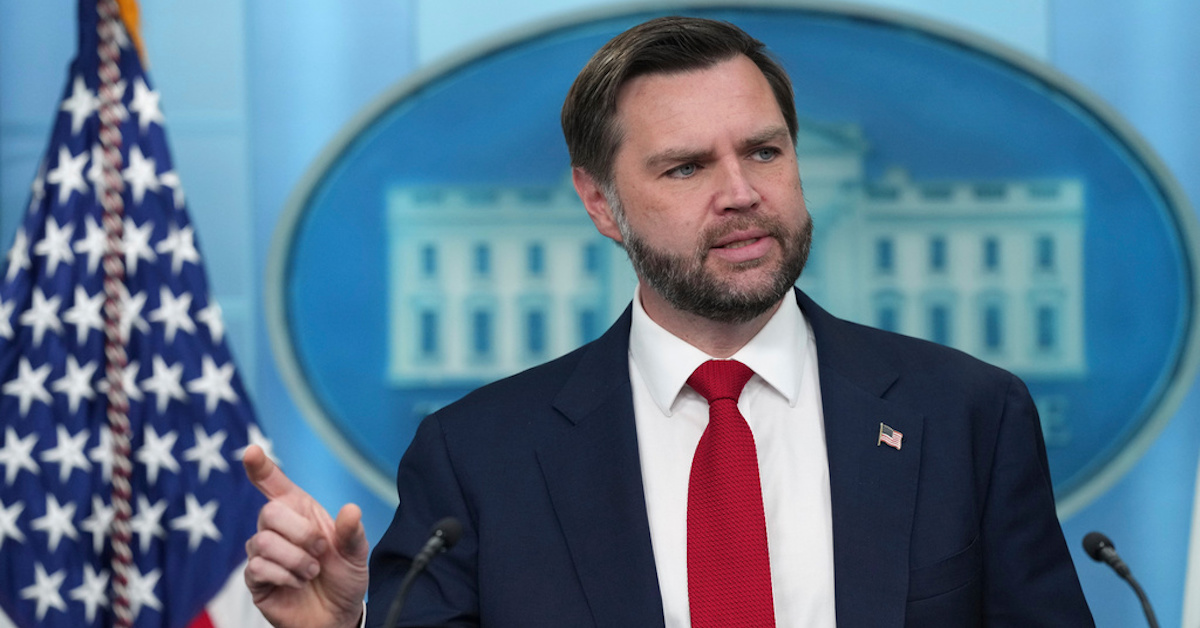
(AP Photo/Jacquelyn Martin)
The Supreme Court sided with a Republican challenge to campaign finance rules on Tuesday, finding in a 6-3 decision that federal limits on coordinated spending between political parties and candidates violate the First Amendment and should be removed.
The court split along ideological lines, with conservative Justices Brett Kavanaugh, Clarence Thomas, Samuel Alito, Neil Gorsuch, Amy Coney Barrett and Chief Justice John Roberts in the majority and liberal cohort Elena Kagan, Ketanji Jackson Brown and Sonya Sotomayor dissenting.
The decision came on the final day of the court’s current term, and considered a case in which Vice President JD Vance was the lead plaintiff.
Writing in his majority opinion, Kavanaugh found:
Applying the First Amendment, this Court has long ruled that a political party possesses a right to make unlimited independent expenditures during a campaign—that is,
expenditures without coordinating with a candidate. … But FECA [Federal Election Campaign Act] still limits a political party’s coordinated expenditures. As the name implies, a political party’s coordinated expenditures are the party’s expenditures on,
for example, advertisements produced or distributed in consultation with a candidate’s campaign. The primary current justification for those limits is to prevent circumvention—that is, to prevent a donor from circumventing the statutory limits on contributions to
candidates by making a large contribution to a party that the party then uses to support a particular candidate.
Trump crowed about the victory on Truth Social:
Kagan wrote in her dissent that campaign finance rules helped to “suppress corruption:”
But today, the Court rewrites the rules, to allow circumvention of the contribution limits. The majority invalidates Congress’s restriction of coordinated expenditures, thus enabling a party to serve as an alternative checking account for a campaign. As a result, a donor will be able to give a party as much as half a million dollars (as compared to the
$7,000 he can give directly to the candidate) to cover the candidate’s bills. And the candidate can seek just such a donation. So the Court ushers back in the same opportunities for quid pro quo corruption that the contribution limits were meant to check.
— —
New: The Mediaite One-Sheet "Newsletter of Newsletters"
Your daily summary and analysis of what the many, many media newsletters are saying and reporting. Subscribe now!







Comments
↓ Scroll down for comments ↓