
Trump’s Meddling Threatens to Crumble Decades of GOP Dominance in Texas

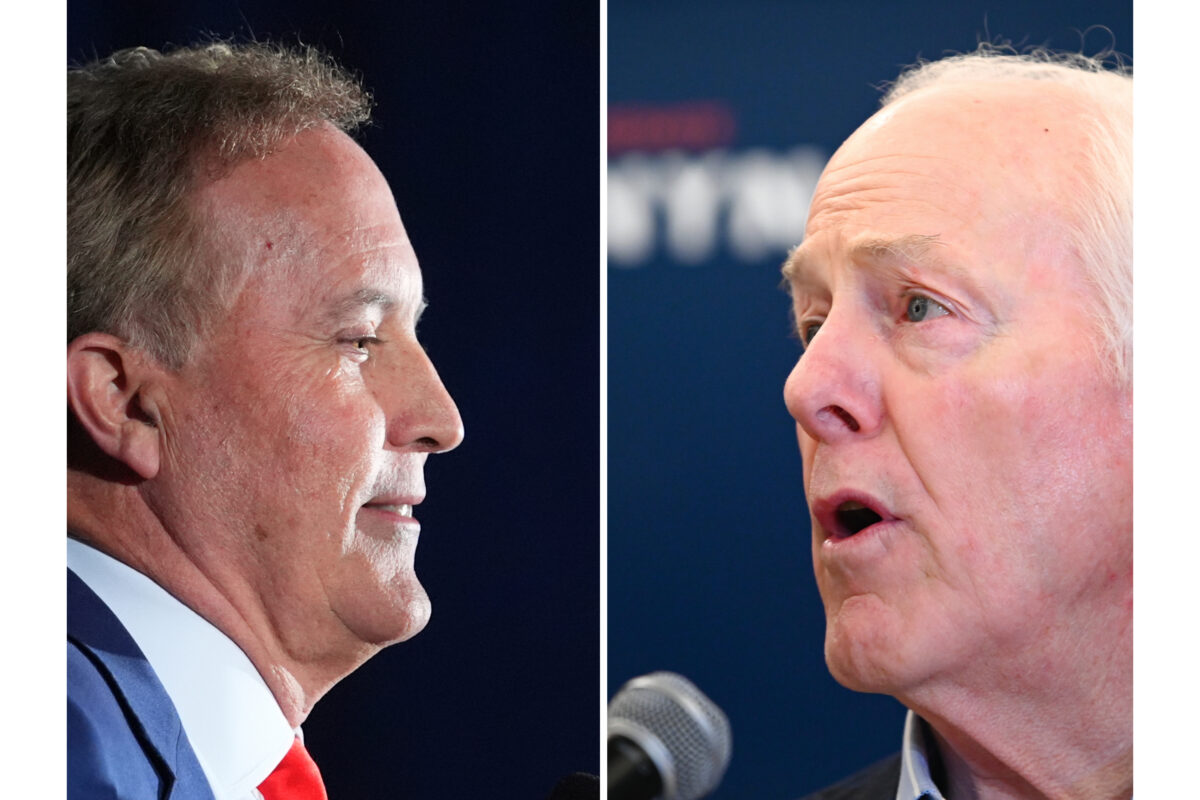
AP Photo/Julio Cortez, Jack Myer
Texas Republicans have enjoyed decades of political dominance in the Lone Star State, holding key statewide offices and a majority in the state legislature since the 1990s, but cracks seem to be forming in the foundation of the GOP’s control — and they trace back to meddling by President Donald Trump.
Texas has had Republican governors since 1995, lieutenant governors since 1999, attorneys general since 1999, majority control of the state senate since 1997 and state house since 2003, as well as every seat on the Texas Supreme Court since the late 1990s.
The Democrats who have attempted to offer a challenge to Texas’s one-party rule have racked up headlines — think State Sen. Wendy Davis’s pink-sneakered filibuster of an abortion bill and former Rep. Beto O’Rourke’s (D-TX) glossy magazine covers — but don’t seem able to rack up enough votes to win.
Sen. Ted Cruz (R-TX) has faced some of the toughest fights but still fended off his Democratic opponents, defeating O’Rourke 50.9% to 48.3% in 2018 and Rep. Colin Allred (D-TX) 53.1% to 44.6% in 2024.
Texas Gov. Greg Abbott (R) annihilated the Democrats each time he has run, beating Davis 59.27% to 38.90% in 2014, former Dallas County Sheriff Lupe Valdez 55.81% to 42.51%, and O’Rourke 54.76% to 43.86% in 2022.
Enter Trump.
To be perfectly and bluntly clear: Democrats still face an uphill battle in statewide races in Texas and the vast majority of legislative and congressional districts. Abbott is all but certain to be re-elected and Republicans should maintain control of the state legislature, Attorney General’s Office, and other statewide offices.
But Trump’s actions and interference have shifted the position of the chess pieces on the board, if not tilted the entire board itself, giving Democrats a chance at finding paths to victory that were not possible in prior election cycles — and making the president himself more vulnerable than he has been in years.
The increasingly brutal Texas Senate primary brawl
Sen. John Cornyn (R-TX) is in the fight of his political life, heading to a runoff to defend his seat against Attorney General Ken Paxton (R), and it’s guaranteed to be viciously brutal. The incumbent Cornyn is widely viewed as a stronger candidate in the general election due to Paxton’s series of scandals, lawsuits, and controversies.
The messy scandals surrounding Paxton and perception he’s a weaker general election candidate spurred a lot of the money backing Cornyn, and West Texas oil billionaire Tim Dunn, who has funneled Scrooge McDuck-levels of money to Paxton and other right-wing candidates over the years, was not on board this time.
But Trump keeping his powder dry in this race contributed to Paxton’s challenge to Cornyn having a chance.
Cornyn’s campaign messaging frequently touted how he voted with the president “over 99 percent of the time” but Trump didn’t endorse him. And while Paxton has gotten support from the MAGA wing of the GOP for his combative, far-right stances, Trump has thus far declined to endorse him either — but by also not endorsing Cornyn, Trump left a pathway clear for Paxton.
Now the two Republicans will head to a May 26 runoff, with both Cornyn and Paxton’s camps and their surrogates firing bombs at each other, while the Democrats are already making nice.
State Rep. James Talarico (D) surpassed Rep. Jasmine Crockett (D-TX) by a comfortable margin; she conceded the race Wednesday morning.
While Crockett “did not directly answer questions about whether she would campaign” with Talarico, “her quick concession and endorsement avoid an ugly situation for Texas Democrats,” reported The New York Times. Crockett tweeted a call for Democrats to “remain united” and “rally around our nominees,” and much of her post-primary griping has been directed at Dallas County election officials over confusion about changes to voting locations and hours, not at Talarico.
Talarico now gets to move on and spend the next few months raising money, shoring up the Democratic base by reaching out to Crockett’s supporters, attempting to win over moderates and independents, and bashing the Republicans — while Cornyn and Paxton are still entangled trying to nuke each other (and provide further ammo for Talarico to use).
Wednesday afternoon, Trump finally indicated he was close to an endorsement, writing a post on Truth Social declaring that he would endorse “soon” and ask the other candidate to “immediately DROP OUT OF THE RACE!”
Trump’s endorsement does carry significant power in Republican primaries, but whether it actually convinces the non-endorsee to surrender seems far less likely here where Cornyn and Paxton have hated each other for so long, and other Trump endorsements in Texas, like Texas Agriculture Commissioner Sid Miller’s re-election bid, flopped.
If Trump endorses Paxton and he wins the runoff, Texas Republicans will be more vulnerable to losing the seat to Talarico. If Trump endorses Cornyn and he wins the runoff, or Cornyn wins the runoff without Trump’s explicit endorsement, the GOP will still be heading to November with over $100 million up in smoke and internecine party squabbles festering for several more months.
Money, Money, Money
“You can’t buy happiness,” sang George Strait in his 1987 song, “You Can’t Buy Your Way Out of the Blues,” but what money can buy is television, radio, and digital ads, field staffers, and get-out-the-vote operations. And every dollar spent on vicious GOP primary infighting is one less dollar that can be spent in the general election.
The bitter Cornyn vs. Paxton battle is the most obvious and extreme illustration of this. It was literally the most expensive Senate primary on record, according to an analysis by AdImpact that calculated more than $128 million had been spent up to Tuesday’s election.
The vast majority of that figure came from the GOP side, with a whopping $98.9 million burned up in what The Barbed Wire called the “all-out war” fought by the campaigns and PACs backing Cornyn, Paxton, and Rep. Wesley Hunt (R-TX), who came in third and was eliminated for the runoff.
Both Cornyn and Paxton are aggressively fundraising with dire messages predicting catastrophic results if their opponent prevails, and they’ll continue to suck up a lot of the media oxygen, both within Texas and nationally. This makes it tougher for other Texas Republicans to get the money and press attention they need to win their own runoffs or fend off their Democratic opponents in November.
In 2022, the Republican Governors Association (RGA) spent nearly $21 million dollars — almost one out of every four dollars spent — to help Florida Gov. Ron DeSantis (R) “run up the score” and help make him a contender in the 2024 presidential election, which obviously didn’t pan out. No rational person believed DeSantis needed the help; he held an insurmountable lead in the polling and a massive cash advantage throughout the election. This understandably led to grumbling from Republicans in other states, like Kari Lake supporters in Arizona who watched her lose to Democrat Katie Hobbs by a razor-thin 0.6%. The RGA spent less than half in Arizona than it did in Florida; an Axios report described the Lake campaign’s TV presence as “paltry.”
What contested congressional races around the country will come up short because the NRSC and NRCC have to burn money to protect seats in Texas?
Never admit a mistake
Trump’s well-documented penchant for refusing to apologize or admit a mistake is at center stage in Rep. Tony Gonzales’ (R-TX) re-election campaign. The embattled representative whose district stretches along the border from San Antonio to El Paso is heading to a runoff after months of shocking headlines about a former staffer of his, Regina Santos-Aviles, who committed suicide by setting herself on fire after he allegedly initiated an affair with her.
The congressman denied any wrongdoing, but text messages shared with reporters by Santos-Aviles’ widower showed Gonzales begging her to send him a “sexy pic,” tell him her favorite sexual position, and her repeatedly refusing and insisting he was “going too far” in pressuring her.
Trump endorsed Gonzales last December, as he had in the congressman’s earlier races, and did not withdraw the endorsement despite the scandal and multiple congressional Republicans calling for Gonzales to resign from Congress and drop out of the race.
Trump did omit Gonzales’s name from a list of Texas endorsements he posted on his Truth Social account but still gave the congressman a shout-out during a rally in Corpus Christi right before the primary.
In Tuesday’s primary, gun rights activist and YouTuber Brandon Herrera got 43.3%, Gonzales got 41.7%, and two other Republican candidates each got a single digit percentage of the votes. Since no candidate got over 50%, Gonzales and Herrera are heading to the runoff.
Texas’s 23rd congressional district has been solidly Republican, but it’s likely to be a heavier lift this time for the GOP, as Gonzales’ scandal has made national news and now Democrats have at least twelve more weeks to use it to attack him and the GOP, or until November if he wins the May 26 runoff.
If Herrera wins, he has his own controversies, including jokes he’s made about veteran suicides and the Holocaust.
Either way, TX-23 will need more attention and more money than in previous elections, with a Trump-endorsed candidate an anvil around the neck of the Texas GOP.
Be careful what you wish for
The wave of retaliatory redistricting around the nation was sparked in Texas, as Trump pushed for the GOP majority legislature to break centuries of tradition and redraw the district maps early instead of waiting for the next U.S. Census in 2030. Texas Republicans did as Trump wished and Abbott enthusiastically embraced the idea, adding redistricting to the agenda for a special session. The Texas Legislature created new maps, they were challenged in court, overturned but later upheld, and the new districts are set for November.
Besides the fact that the court battles and necessary outreach efforts to inform voters about their new districts ate up funds (see above, every dollar spent for one Trump-induced expenditure is a dollar that can’t be spent elsewhere), the Republicans’ redistricting strategy may in fact be flawed down to its very foundation.
The redistricting was calculated largely based on Trump’s 2024 win, in which he performed better with some voter groups where Republicans had struggled in the past, like women, young people, and Latinos.
Democrat have been wildly outperforming expectations and past history in special elections over the past year, and the trend shows little sign of reversing before this November. Many of Trump’s gains have totally collapsed since his re-election, as campaign promises to improve the economy have faltered and public opinion on his immigration crackdown has significantly soured, even among Republicans.
Texas Republicans who drew congressional districts assuming they’d hold on to Trump’s numbers may have created a trap for themselves, especially in heavily-Hispanic districts like TX-23.
As an example, if a hypothetical district was Trump +8 in 2024 and was redrawn assuming Hispanic support for Republicans that no longer exists, that district might now be only Trump +4 or +5. Factor in a troubled candidate like Gonzales, the customary drag a president’s party faces in midterms, and the albatross of Trump’s unpopular immigration policies, and a district where a Republican should have coasted to victory is now up for grabs. And even if the seat isn’t lost, the effort to defend it will expend money and energy that could have been devoted elsewhere in Texas or other contested states.
Congressional Republicans are fighting to protect narrow majorities in the House and Senate, with Democrats fervently vowing to investigate, impeach, and even possibly prosecute Trump and numerous officials in his administration. Cue up Alanis Morissette, because the president may just have built his own trap with his meddling in a state that’s been red since that song was released.
This is an opinion piece. The views expressed in this article are those of just the author.
New: The Mediaite One-Sheet "Newsletter of Newsletters"
Your daily summary and analysis of what the many, many media newsletters are saying and reporting. Subscribe now!











Comments
↓ Scroll down for comments ↓