Stephen Miller Went on CNN and Admitted the U.S. Invaded Venezuela

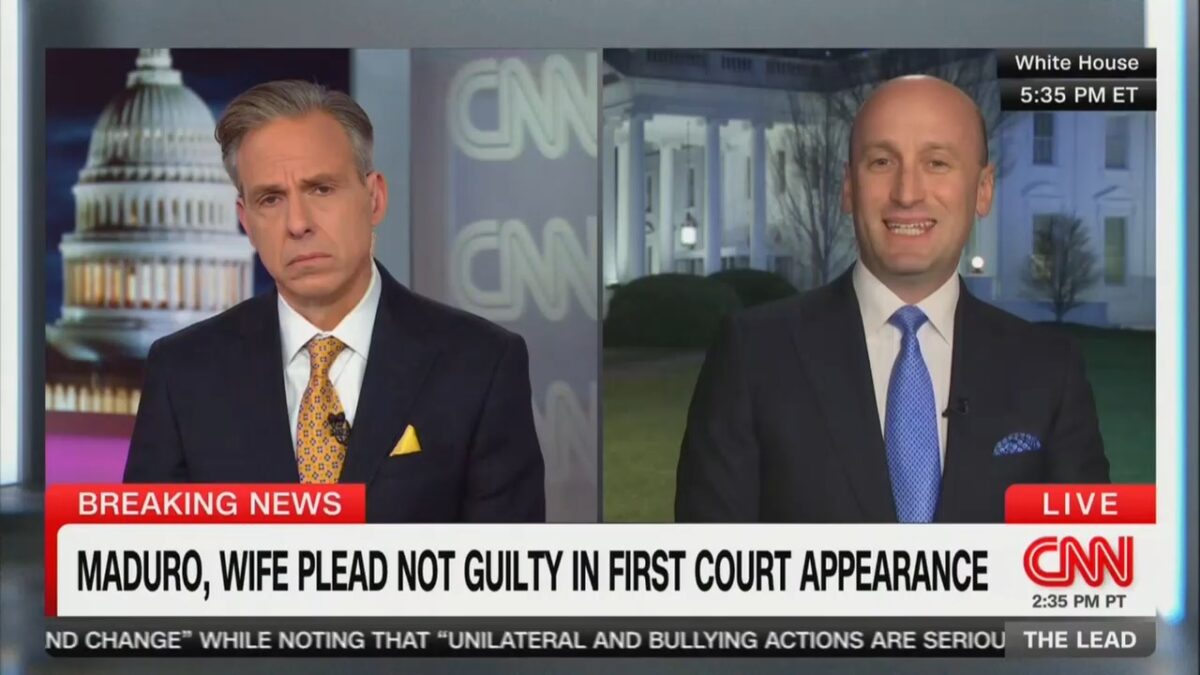
Stephen Miller is the White House deputy chief of staff, the architect of the Trump administration’s immigration agenda, and a senior official involved in the operation that led to the capture of Venezuelan leader Nicolás Maduro.
On Monday afternoon, Miller went on CNN and described an American invasion of Venezuela. He acknowledged a military assault on Caracas, lethal combat with foreign forces, the seizure of a head of state, and U.S. control over another country’s economy. He said all of it on live television.
Those statements matter because the Trump administration is hastily trying to frame Maduro’s removal as a criminal extradition. That framing collapses under Miller’s account. A criminal arrest proceeds through courts, warrants, treaties, and custody transfers. A military invasion proceeds through force. An invasion bypasses Congress, violates the United Nations Charter’s ban on aggressive war, and establishes precedent for presidential seizure of foreign leaders without legal constraint. Miller described the latter.
The administration has articulated no legal authority for what was clearly a military operation. The administration has released no public authorization from Congress approving the use of U.S. military force in Venezuela. No formal legal justification has been offered explaining how the seizure of a sitting foreign head of state complies with constitutional war powers or international law. Absent congressional authorization or a recognized self-defense rationale, unilateral military action against a sovereign government falls outside established legal frameworks. Miller’s description of the operation only sharpens that gap.
The interview carried institutional significance. In the weeks before it aired, the White House publicly pressured CNN to book Miller, treating airtime as an entitlement. At the same time, The Washington Post reported that Miller is under consideration for an expanded role overseeing post-Maduro operations after President Trump declared the United States would “run” Venezuela. With the secretary of state unavailable to absorb another portfolio, Miller has emerged as a governing figure rather than a messenger.
Miller began by describing the operation as a military assault. “The United States of America launched an assault force into Venezuelan territory,” he said, calling it a “daring midnight assault into Caracas.” Assault forces do not conduct extraditions. Midnight raids into foreign capitals do not occur under judicial authority. Miller made no reference to courts, warrants, or cooperation with Venezuelan institutions.
He described armed combat. U.S. special forces engaged in “direct gunfire with elite Cuban guards,” Miller said. “Every single kill was an enemy kill.” He added that reported casualty numbers were “probably lower than the actual number that were killed.” That language describes a battlefield.
Miller identified the dead as Cuban personnel. He said Maduro relied on “armed Cuban guards” because he “didn’t trust his own people to keep him safe.” Those guards sustained “massive numbers of casualties.” Killing third-country security forces inside a sovereign nation constitutes armed conflict.
Miller asserted there were no civilian casualties. “I didn’t see any reports of any civilian casualties,” he said, referring to a nighttime urban assault involving heavy gunfire. The certainty of that claim aligns with Miller’s description of the operation as a combat mission.
Miller then described the aftermath. “The United States of America is running Venezuela by definition,” he said. He explained that U.S. military forces are positioned outside the country, that Washington sets “the terms and conditions,” and that Venezuela requires U.S. permission “to do commerce” and “to run an economy.” That is a description of de facto control.
He extended that control to political compliance. Individuals indicted by the United States and still inside Venezuela “could become part of a future conversation,” Miller said. Officials seeking a role in the transition should “cooperate fully and completely with the United States.”
When Jake Tapper summarized the situation — “You invaded the country” — Miller responded, “Damn straight we did.”
Stephen Miller admitted to acts that constitute war on cable television. No institution with constitutional authority has responded. The House has issued no statement. The Senate has called no hearing. The Pentagon has offered no clarification. The Justice Department has drawn no distinction between military action and criminal process. The United Nations Security Council has scheduled no emergency session. Allied governments have issued no formal protests.
Institutional silence constitutes consent.
Tapper asked direct questions and allowed Miller to answer without interruption. That approach produced a clear record of Miller’s statements.
The Trump administration has no intention of contradicting Stephen Miller. Miller said exactly what he was meant to say. He described a war because the administration has abandoned the need for legal cover.
This was a test. A senior White House official admitted to invading a sovereign nation, killing foreign nationals, and asserting control over another country’s government on live television.
Miller’s interview was not a gaffe. It was doctrine. And it was a test: Can a senior White House official admit to invading a sovereign nation, killing foreign nationals, and asserting control over another country’s government on live television without facing institutional consequences? So far, the answer is yes.
This is an opinion piece. The views expressed in this article are those of just the author.
New: The Mediaite One-Sheet "Newsletter of Newsletters"
Your daily summary and analysis of what the many, many media newsletters are saying and reporting. Subscribe now!







Comments
↓ Scroll down for comments ↓