Fox & Friends Asks Why People Link Trump’s Language with Mosque Shooter. Here’s Why.

The hosts of Fox & Friends are just the latest pro-Trump figures to wonder aloud why anyone would link Donald Trump‘s language with the words and actions of the terrorist mass murderer who killed 50 people at two mosques in New Zealand. As a public service, here are some possibilities.
On Monday’s episode of Trump’s favorite morning show, host Brian Kilmeade commented on Trump Chief of Staff Mick Mulvaney‘s appearance on Fox News Sunday, during which Mulvaney decried any link between Trump’s language and the shooter’s.
“They are saying why is he using the same language as that 28-year-old killer in New Zealand,” Kilmeade said, referencing Trump’s use of the word “invasion,” adding “He is not using the same language. That’s the way Trump talks to illustrate what he sees as a problem at the border. Nothing to do with gun control in New Zealand.”
Co-host Jedediah Bila chimed in by slamming the media for connecting Trump’s rhetoric to the shooting — centering on comments made by ABC’s George Stephanopoulos Sunday on This Week.
He’s like ‘Oh, we’re not blaming Trump,’ he has to say that as a preface, but then he follows it up, and they all follow it up, ‘but let’s examine Trump’s language.'”
“No, that is a suggestion then that you are linking President Trump to this terrorist, which you can’t do regardless of political ideology, you cannot link a maniac and the workings of a maniac to any politician left or right, that is insane,” Bila added. Watch that clip above, via Fox News.
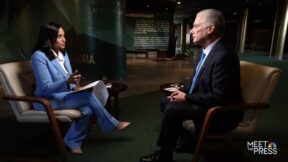
Apparently, Fox News Sunday host Chris Wallace did not get that memo, because that is exactly what he did during his interview with Mulvaney, repeatedly noting that Trump is not to blame, but pressing Mulvaney for a solid five minutes on Trump’s past statements, including the “invasion” quote.
As it turns out, though, Wallace was less than thorough, so in the interest of fairness, we have compiled some of the reasons a person like Chris Wallace or George Stephanopoulos might wish to examine Trump’s language in light of this event, while also not blaming Trump for the shooter’s actions. Sometimes, this sort of material is referred to as “receipts” by the kids.
The case for these links begins with the terrorist mass shooter’s manifesto, which expresses support for Trump by name as ““a symbol of renewed white identity and common purpose,” and which refers to Muslim immigrants as “invaders.” The shooter carried out his attacks at two Mosques, and chose his victims on the basis of their Islamic faith.
Trump has frequently referred to undocumented or asylum-seeking migrants as an “invasion,” which is, itself, a fairly strong basis on which to establish a link. And Trump appears to be somewhat cognizant of the inflammatory nature of the premise, as he frequently notes that “people don’t like” the term as he applies it.
Trump has also repeatedly linked this “invasion” to terrorism, and explicitly linked those concerns to Muslims — by claiming “prayer rugs” were found at the border — and people from the Middle East. But his repeated claims about “unknown Middle-Easterners” flooding into the country were debunked by news outlets, and by Trump himself. When confronted about the claim, he admitted there was “no proof of anything.”
And Trump’s claims about terrorists infiltrating the southern border were thoroughly debunked by his own State Department, as well as by Fox News’ Chris Wallace, who demolished the false claim in an interview with White House press secretary Sarah Huckabee Sanders.
Those are just the receipts that involve Trump’s explicit assertions that Muslims are part of what Trump describes as an “invasion” at our southern border. But there is a much larger body of statements and actions that explicitly paint Muslims as a threat, or otherwise evince anti-Muslim views.
Some of these predate his presidential candidacy, such as his relentless promotion of the “birther” conspiracy theory, part of which pejoratively claimed that then-President Barack Obama was a secret Muslim. These elements intersected on the campaign trail in 2015 when a questioner at a town hall made that accusation, claimed “We have a problem in this country called Muslims,” and asked “When can we get rid of them?”
Trump replied that “a lot of people are saying that and a lot of people are saying that bad things are happening and we’re going to be looking at that and plenty of other things.”
But Trump didn’t just explicitly endorse getting “rid of” Muslims,” he turned those words into policy by proposing a “total and complete shutdown of Muslims entering the United States.”
Leading up to that announcement, Trump made many explicitly anti-Muslim statements. There was his now-infamous claim to have seen “thousands and thousands” of people from “areas with large Arab populations” in New Jersey cheering when the Twin Towers were destroyed on 9/11, an utterly false claim:
Around the same time, Trump also introduced the idea of targeting mosques for surveillance, and said he would even be willing to shut down mosques because “the hatred is embedded.”
During a Dec. 13, 2015 interview, Chris Wallace asked Trump if his Muslim ban would apply to Muslims from countries like Indonesia or Canada, and Trump replied “There’s a sickness. They’re sick people. There’s a sickness going on. There’s a group of people that is very sick.”
In March of 2016, Trump told CNN’s Anderson Cooper “I think Islam hates us. There’s something there that — there’s a tremendous hatred there. There’s a tremendous hatred. We have to get to the bottom of it. There’s an unbelievable hatred of us.”
During a March 22, 2016 interview on Fox Business Channel following a terrorist attack in Brussels, Trump said “We’re having problems with the Muslims, and we’re having problems with Muslims coming into the country,” and again said “You have to deal with the mosques, whether we like it or not, I mean, you know, these attacks aren’t coming out of — they’re not done by Swedish people.”
That same day, Trump also told then-Today Show host Matt Lauer that Muslims don’t assimilate, and they “want to go by sharia law. They want sharia law. They don’t want the laws that we have. They want sharia law.”
There are many more less direct examples, such as Trump’s running feud with the family of slain Muslim-American serviceman Humayun Khan — which featured an insinuation that Khan’s mother was “not allowed to speak” because of her religion — but the examples cited here serve as a good starting point for those wondering why someone like Chris Wallace would question Trump’s language in the wake of the massacre in New Zealand.
New: The Mediaite One-Sheet "Newsletter of Newsletters"
Your daily summary and analysis of what the many, many media newsletters are saying and reporting. Subscribe now!



Comments
↓ Scroll down for comments ↓