Trump Claims to Know Where Iran’s Sleeper Cells Are. Why Isn’t He Arresting Them?

If the United States government knows where Iranian sleeper cells are operating inside the country, someone should probably arrest them.
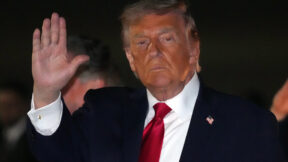
Nobody on the tarmac at Joint Base Andrews seemed particularly interested in that question on Tuesday, when President Donald Trump casually mentioned that federal authorities already have eyes on most of the hostile foreign operatives he believes entered the country during Joe Biden’s presidency. The reporters present heard the claim, noted it, and moved on.
That response tells you more about how Washington journalism works today than anything Trump actually said.
The exchange began when Fox News correspondent Peter Doocy asked a legitimate question. With tensions between Washington and Tehran escalating, he wanted to know whether Iranian sleeper cells might already be operating inside the United States. Trump said he’d been briefed.
“A lot of people came in through Biden with his stupid open border,” Trump replied. “But we know where most of them are. We’ve got our eye on all of them, I think.”
Sleeper cells exist because intelligence services cannot find them. Their entire operational value to a foreign adversary depends on invisibility. Once you know where they are, they aren’t sleeper cells anymore — they’re the subjects of counterterrorism investigations, and then they’re in handcuffs. Trump wasn’t describing a vague threat. He was describing a specific situation: hostile operatives, known locations, active surveillance. The follow-up writes itself.
Nobody asked it.
The conversation drifted back to Biden’s immigration record, the moment dissolved into the broader noise of the gaggle, and the contradiction at the center of Trump’s claim went unexamined.
Part of this is the exhaustion theory, which is real. Reporters who have covered Trump for a decade know how these exchanges go. Press him and he expands the claim, reframes it, and buries the original question under a pile of new assertions. Journalists have rationally adjusted.
But the exhaustion theory is the generous interpretation. The less generous one is about access.
Tarmac gaggles aren’t press conferences. They’re informal, brief, and entirely at the president’s discretion — and the White House controls who gets close enough to ask questions in the first place. Reporters who corner the president on a logical contradiction in front of cameras don’t always get invited back. That dynamic is rarely stated explicitly, but it doesn’t need to be. Everyone in that circle understands it.
That incentive structure is particularly complicated for Doocy. His question was sharp and legitimate. But Doocy works for Fox News, a network that has built much of its identity around Trump. Pressing the president on the sleeper cell logic would have served the public interest. It also would have made the president look confused and evasive on camera — which creates its own set of institutional problems for a network in that position.
The result is an arrangement that has calcified over years. Trump performs certainty. Reporters recognize the performance. The access continues. Everyone moves on.
Most of the time, the stakes are low enough that this equilibrium is merely embarrassing. Trump exaggerates a crowd size or invents an economic superlative and the room absorbs it without incident.
The sleeper cell remark is different. A president suggesting that hostile Iranian operatives are scattered around the country while the government keeps a watchful eye on them is not a throwaway boast. It is either an alarming admission about the state of domestic counterterrorism or a fabrication delivered with presidential authority during an active foreign policy crisis.
Either version deserves a follow-up question.
Instead, the moment passed. The bravado went unchallenged — not because it was convincing, but because the room had already decided, somewhere along the way, that some questions aren’t worth the cost of asking.
Watch above via CSPAN.
This is an opinion piece. The views expressed in this article are those of just the author.
New: The Mediaite One-Sheet "Newsletter of Newsletters"
Your daily summary and analysis of what the many, many media newsletters are saying and reporting. Subscribe now!







Comments
↓ Scroll down for comments ↓