Beto O’REKT: Lessons Learned from the First Democratic Debate

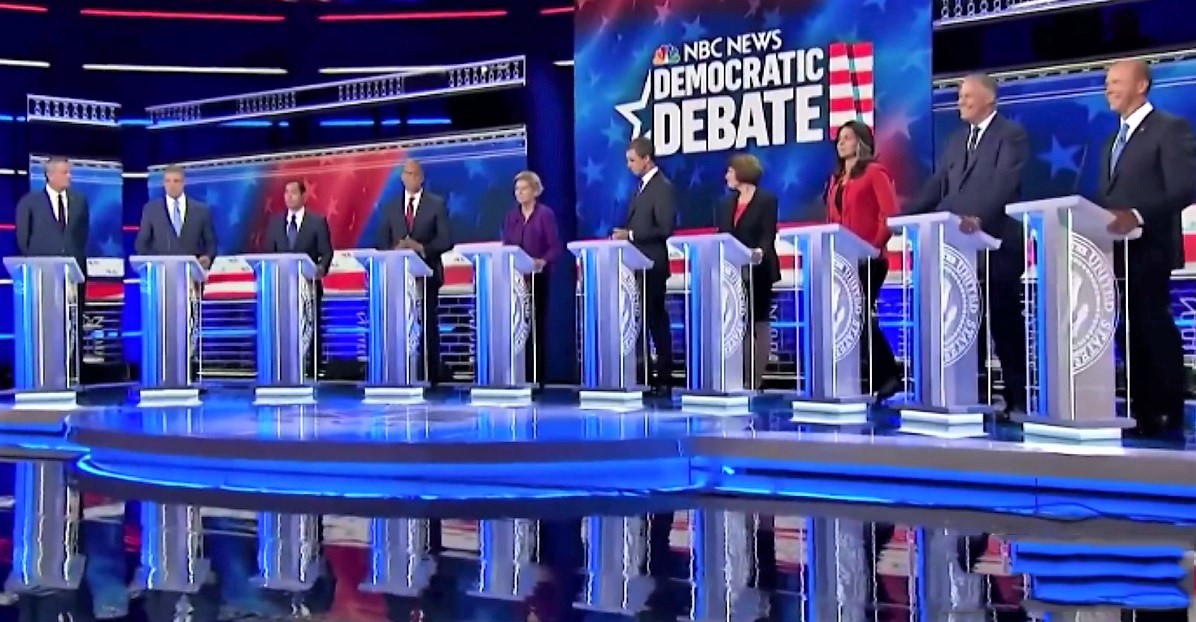
Wednesday night’s NBC News Democratic Presidential Debate is in the can now, and rather than just rank the winners and losers, it’s important for everyone involved to take away the right lessons, starting with the sad tale of Beto O’Rourke.
There’s a strong consensus that Massachusetts Senator Elizabeth Warren and O’Rourke were, respectively, the big winner and loser of the night, and it’s easy to miss the connection between those two performances.
Lesson 1: Be Prepared
Watching O’Rourke get his clock cleaned by Julian Castro, and lurch through the rest of the night like a nervous flu patient, it’s tempting to chalk it up to O’Rourke having a bad night, or needing to eat some Wheaties or just a mismatch of the candidate’s skills and the format.
But O’Rourke’s demise was eminently preventable. Just over a week ago, CNN’s Jake Tapper gave O’Rourke some valuable and free debate prep when he spent several minutes trying to get an answer out of him on the very issue that Castro wrecked him on. His answer was lousy then, and it remained lousy Wednesday night. Yes, some Wheaties might have helped, but this was, above all else, a lack of preparation.
Warren, by contrast, coasted to victory on the strength of her second-nature command of issues and skill as an orator, qualities she has demonstrated in town halls. But Warren’s win carries with it some red flags.
Lesson 2: Winning Isn’t Everything
The feat that Warren pulled off Wednesday night was meeting fairly high expectations, but her performance also left some questions unanswered. Some of this is beyond her control, such as the fact that none of the other participants mounted much of a direct challenge to her. As the only top-tier (polling-wise) candidate on the stage, Warren floated above it all as the others tried to take chunks out of each other.
Unfortunately, that leaves unanswered an important question for voters: Can Warren brawl? Her strength in town halls is a feature of stellar policy and campaigning chops, but voters also want someone who can take the fight to someone like Donald Trump.
Slightly more in Warren’s control is the fact that after a dominant start, she was relegated to the background for long stretches of the debate. The moderators are partially to blame, but a more aggressive Warren could have elbowed her way in on topics like immigration.
There are good reasons for not doing that, however. The candidates who did butt in often came off seeming desperate, and it was arguably good strategy for Warren to retain the frontrunner’s composure, and not to punch down. It also leaves Warren with something to prove. And going first means that the glow of Warren’s performance could fade quickly when the fur flies Thursday night.
Lesson 3: Seize the Moment
Warren gave the best all-around performance, but the moment of the night belonged to Minnesota Senator Amy Klobuchar. When Washington Governor Jay Inslee overreached in burnishing his pro-choice credentials, Klobuchar shot them back at him with hot mustard.
Inslee called himself the “one candidate that’s actually advanced the ball” on reproductive freedom and health care, and Klobuchar cut in with: “I just want to say, there’s three women up here that have fought pretty hard for a woman’s right to choose.”
And in a similar vein, Julian Castro made the most of his screen time, especially with his takedown of O’Rourke.
In the viral age, scoring moments like that when you’re polling at around one percent is worth its weight in gold. You can’t plan for a moment like that, but when it presents itself, you have to grab it. That’s part skill and part luck, but you also have to be listening rather than waiting to talk.
Lesson 4: Nobody’s Going Anywhere
One surprise of the night is that of the 10 candidates who took the stage, only three were clear losers. O’Rourke, Tim Ryan, and John Delaney gave poor performances that might make a humble person bow out.
But the others turned in performances that, to varying degrees, figure to give each of them a lift, and a reason to hang in there for the next debate. New York Mayor Bill de Blasio didn’t get much screen time, but was consistently on the attack, including an early dig at O’Rourke. During a freewheeling segment on health care, de Blasio asked O’Rourke, “Why are you defending private insurance to begin with?”
Despite taking that hard shot from Klobuchar, Governor Inslee made the most of his limited screen time (he ranked dead last in minutes and words spoken) by eloquently defining his climate change-driven candidacy.
New Jersey Senator Cory Booker got the most screen time, a result that’s way out of alignment with his place in the polls, and it paid off. Booker was the top-searched Democrat during the debate according to Google Trends.
But even more so than Warren, Booker has something to prove when it comes to brawling with Trump. He showcased a little bit of that in an exchange with Gabbard, jumping on her answer about LGBTQ rights by saying that, “It’s not enough just to be on the Equality Act. I’m an original co-sponsor. We need to have a president that will fight to protect LGBTQ Americans every single day from violence in America.”
Congresswoman Tulsi Gabbard had a good night relative to her position in the polls, as well, and knocked Congressman Tim Ryan back on his heels during an exchange on Afghanistan policy. After Ryan said, five times, that we need to be “engaged” in situations like Afghanistan, Gabbard said, “Is that what you will tell the parents of those two soldiers who were just killed in Afghanistan? Well, we just have to be engaged? As a soldier, I will tell you, that answer is unacceptable.”
Ryan’s response? “I don’t want to be engaged.”
Almost every candidate did well enough to help themselves, and O’Rourke, despite his poor performance, is unlikely to fold up.
Lesson 5: Ignore Most of Wednesday Night
It’s just as important to avoid the wrong lessons as it is to learn the right ones from Wednesday night’s debate. What worked for Warren and failed for Beto won’t necessarily translate to similarly situated candidates Thursday night, or beyond.
Thursday night’s field of Bernie Sanders, Kamala Harris, Joe Biden, Pete Buttigieg, Michael Bennet, Marianne Williamson, Eric Swalwell, Kirsten Gillibrand, Andrew Yang, and John Hickenlooper presents a completely different set of dynamics.
While Warren was the lone top-polling candidate, and the other candidates chose easier targets, Thursday night’s lineup is chock-full of opportunities to punch up. Biden, Sanders, and Buttigieg will likely face some blistering attacks, as they have high profiles and will have few natural allies onstage.
But especially in Biden’s case, the lower tier candidates stand a greater chance of being smacked down by a field with many skillful debaters. Mayor Pete and Sanders will likely be put to the test most often, and have the most to lose.
Harris, who occupies the same general polling tier as O’Rourke, won’t be as ripe a target and has debate skills to spare. But she also has to meet high expectations in a format that seems tailor-made for her.
Gillibrand is also a proven brawler who could score a surprise knockout or two, as well.
Another big difference going forward will be the questions that candidates are asked. Wednesday night was relatively free of gotcha-style questions like the Boston Marathon bomber’s voting rights, but Thursday night features candidates who are more likely to draw such awkwardness. Biden and Buttigieg both figure to face tough questions based on current events, and Sanders is already a proven magnet for the kinds of questions that no other candidates face (see Boston Marathon bomber).
Those questions can also be a gift if they are handled properly, but no one should be under the delusion that this debate will be as easy as Wednesday night’s.
This is an opinion piece. The views expressed in this article are those of just the author.
New: The Mediaite One-Sheet "Newsletter of Newsletters"
Your daily summary and analysis of what the many, many media newsletters are saying and reporting. Subscribe now!







Comments
↓ Scroll down for comments ↓